We Ran a Panel on What ChatGPT Cites When People Ask Which Tool to Use
A Semrush panel of 180 real buying questions shows which domains AI assistants cite for content tools, and why narrow questions get thinner, easier-to-win answers than broad ones.
Before your next customer ever opens your homepage, there is a good chance they already asked an AI assistant which tool to use. Not "what is content marketing," a real comparison question: which platform does this, which one is cheaper, which one a small team can actually run. The assistant answers with two or three named products and a source it decided to trust. We ran a panel to see exactly what that answer looks like today, for the category of content and social media tools, and the pattern is specific enough to act on.
The panel: what we actually measured
The source is a Semrush AI Visibility panel run against ChatGPT (United States, English), covering roughly 180 real buying-intent questions about content and social media tools, captured 2026-09-06 to 2026-09-08. Each question is phrased the way a real buyer would type it into a chat box, not a search bar: "platforms best for consultants turning case studies into educational posts," "tools to keep salesy CTAs subtle and aligned with educational content," and similar. For each one, the panel recorded which named products the assistant mentioned, in what order, and which real domain the answer cited as its source.
Two findings from that panel matter more than any single ranking: who the assistant trusts as a source, and what buyers are actually asking before they pick a tool.
Where AI assistants actually get their answers
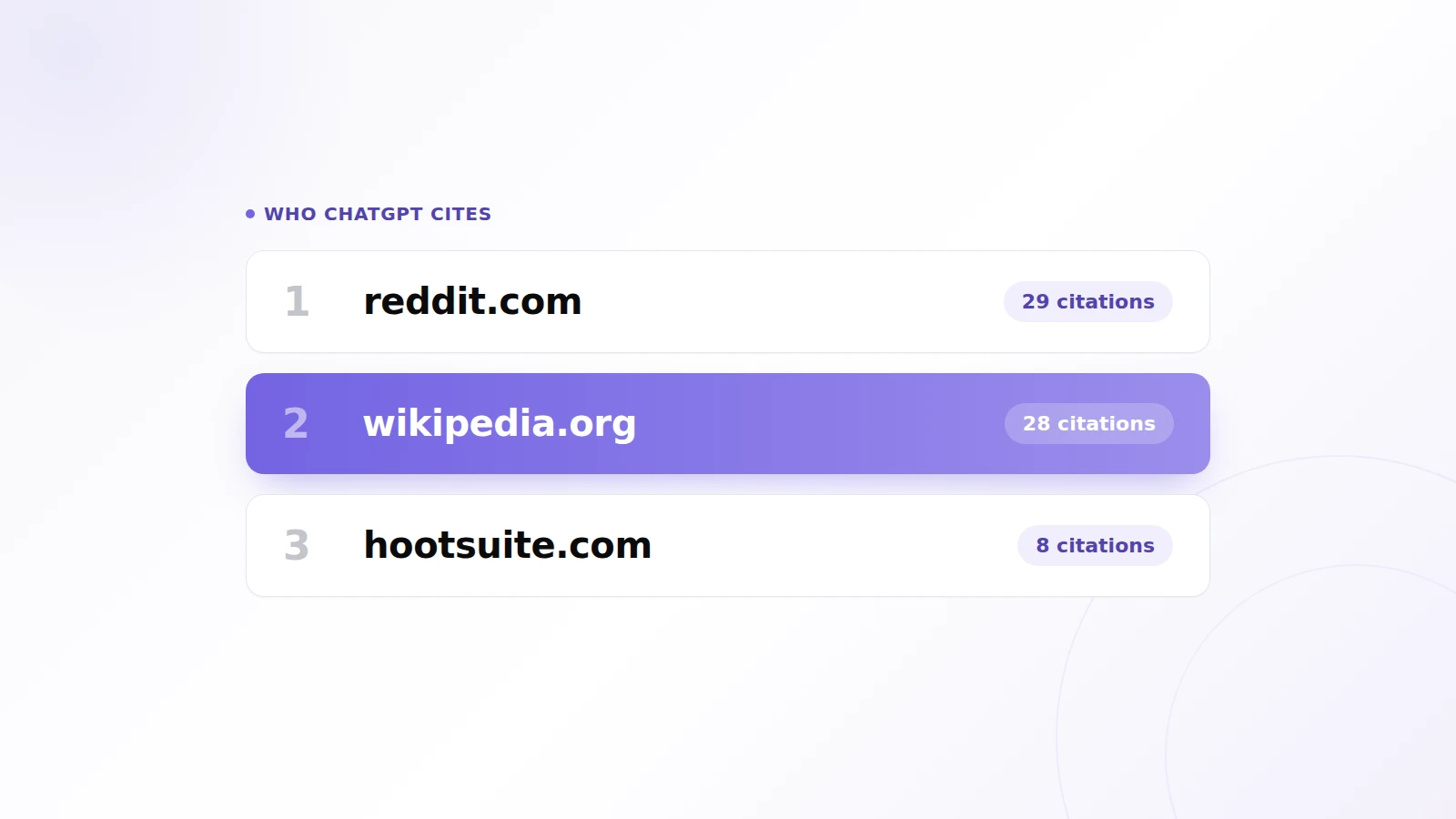
When ChatGPT answers a question about content or social media tools, it does not invent the answer from nothing. It reaches for a source, and the panel logged which real domains show up behind those answers most often.
| Domain | Citations in the panel |
|---|---|
| reddit.com | 29 |
| en.wikipedia.org | 28 |
| hootsuite.com | 8 |
| business.linkedin.com | 7 |
| blog.hootsuite.com | 7 |
Look at what those five domains actually are. Two of the top three, Reddit and Wikipedia, cannot be bought or optimized into existence. An assistant cites Reddit because real people already argued about the question there, and it cites Wikipedia because a canonical entry already answers the definitional half of it. Neither is a marketing channel. Neither takes a purchase order.
The next three rows tell a different story. hootsuite.com, business.linkedin.com, and blog.hootsuite.com are, between them, one company's own published content and one platform's own documentation, cited repeatedly for the simple reason that they exist and answer the question directly. Nobody paid for that placement. Hootsuite got cited by publishing the reference material the model now quotes back. That is the entire playbook, stated plainly: write the page that answers the real question, publish it where an assistant can find it, and it starts showing up as the source months later, at zero marginal cost per citation.
What buyers are actually asking before they choose a tool
The panel also classified every question by intent. Research questions, someone still learning the category, made up 44%. Comparison questions, someone actively choosing between named options, made up 35%. Improvement questions were 16% and pure education 6%. Narrow that down to questions specifically about price, and the split gets sharper still: 84% of pricing questions were comparative. A buyer who asks an assistant about cost is almost always already comparing two or three real names, not wondering what a fair price looks like in the abstract.
That has a direct consequence for how a page should be written. A third of your future readers arrive already comparing. A page that refuses to name a competitor, refuses to state a real price, or answers in vague marketing language does not get quoted in an answer that is fundamentally about choosing between options. The pages that earn the citation are the ones honest enough to say the quiet part: here is what this costs, here is how it differs from the other two names you are already considering.
Some of the real questions in the panel show how specific this gets. "Platforms to collaborate with a small team to draft and approve posts before they go live" returned seven named tools. "Tools allowing direct upload and scheduling of LinkedIn-native documents and PDFs" returned eight. "Platforms best for marketers managing multiple brands' LinkedIn presence at once" returned seven. And the narrowest question in the set, "tools that automatically format LinkedIn posts with line breaks, emojis, bold," returned only two named tools in the entire panel.
The pattern: narrow questions have thin answers
That last number is the one worth sitting with. A broad question about scheduling or content ideas pulls in ten, twelve, sometimes fourteen named competitors, and the citation credit spreads thin across all of them. A specific, narrow question, one particular workflow instead of the whole category, can return as few as two. Fewer real answers exist for it, which means whichever brand actually publishes a clear, specific answer to that narrow question has a real shot at being the one an assistant reaches for.
This inverts the instinct most content plans start from. The temptation is always to write the broad piece, the ultimate guide to the whole category, because it sounds like it should capture the most ground. The panel says the opposite: the broad piece competes against everyone, and the narrow piece competes against almost no one. A page that answers "can a small team approve a post before it goes live, inside the tool, without exporting anything" is competing for a citation against a handful of real answers, not a hundred.
How to check what AI says about your own category
You do not need a research panel to start. A version of this check takes twenty minutes and tells you exactly where you stand today.
- Write down five to ten real buyer questions. Not keywords, questions, phrased the way a person actually types into a chat box the week before they decide. "Which tool lets a small team approve a post before it goes live" is a real question. "Content approval software" is a keyword.
- Ask each one to ChatGPT, Perplexity, and Google's AI Mode, in a fresh, signed-out session so the answer is not shaped by your own history. Read the whole answer, not just the first name mentioned.
- Write down what you actually see. Which named brands came up, in what order, and which real domain the answer cited as its source. Do this the same way every time so a later check is comparable to this one.
- Repeat it monthly, not once. A single check tells you where you stand today. A repeated one tells you whether anything you publish is actually moving the needle, or whether the same two domains keep winning every question regardless of what you ship.
If a genuinely narrow, specific question in your own category keeps returning a thin or generic answer, that is not a gap to worry about. It is the cheapest citation available, and it is sitting there unanswered because most brands are busy writing the broad piece instead.
Frequently asked questions
What is generative engine optimization (GEO)?
GEO is the practice of writing and structuring content so an AI assistant, ChatGPT, Google AI Mode, Perplexity, and similar tools, chooses to cite it when answering a question. It shares a lot with SEO (real substance, real structure, real sourcing) but optimizes for a different moment: not a ranked list of ten blue links, but the two or three sources an assistant actually reads from and names in its answer.
Do AI assistants actually name specific brands when people ask which tool to use?
Yes. In a Semrush panel of roughly 180 real buying-intent questions about content and social media tools run against ChatGPT (US, 2026-09-06 to 2026-09-08), most answers named specific products by name, ranked them, and in many cases scored how favorably each was described. A third of the questions in the panel were already comparison intent, someone actively choosing between named options, not asking what a category is.
Which domains do AI engines cite most when answering software questions?
In the same panel, the most-cited domains behind the specific tool answers were reddit.com and wikipedia.org, followed by a competitor's own blog and help center content. Two of the top three cannot be bought, only earned through real discussion or a canonical reference entry. The rest were a single competitor's own published content marketing, cited repeatedly because it existed and answered the question directly.
How can I find out what ChatGPT says about my own product category?
Write down five to ten real questions a buyer would ask right before choosing between options in your category, phrased the way a person actually types them, not a keyword. Ask each one to ChatGPT, Perplexity, and Google's AI Mode in a fresh, signed-out session. Note which named brands come up, in what order, and which real domain each answer cites as its source. Repeat monthly. A single check tells you where you stand today; a repeated one tells you whether anything is moving.
Is optimizing for AI citations the same as SEO?
Related, not identical. Both reward real substance, clear structure, and honest sourcing over thin or generic copy. The difference is the surface: SEO competes for a rank among ten results a person scans themselves, GEO competes to be one of the two or three sources an assistant actually reads and repeats in its own words. A page built to rank can fail to get cited if it never states a checkable fact plainly, and a page that never ranks can still get quoted if an assistant finds it useful enough to summarize.
Does a narrower, more specific question get easier or harder answers?
Easier to be cited on, in the panel's own data. Broad questions pulled in ten or more named competitors, spreading citation credit thin. Narrow, specific questions, a particular workflow or a particular pair of features, returned as few as two named tools total. Fewer real competitors are actually answering the specific question, which is exactly where a smaller brand has the best odds of being the one cited.
Sources and further reading
- Semrush AI Visibility panel (ChatGPT, United States, English), 2026-09-06 to 2026-09-08, approximately 180 buying-intent questions about content and social media tools.
- For what actually gets an individual LinkedIn post cited by name, see our guide to the AI writing tells that give a post away, and for what gets a LinkedIn URL specifically cited, see LinkedIn is the #2 most-cited source in AI search.
- See how Blendin is positioned against named alternatives on the comparison hub, including Blendin vs Buffer and Blendin vs ContentStudio.