Why Your Writing Sounds Like AI (And the Real Fixes)
The em dash is only a clue. Here are the real tells that make writing sound like AI, the words that give you away, why detectors miss them, and how to fix them.
Somewhere in the last year, a punctuation mark went on trial. Scroll any comment section and you will find someone pointing at a long dash and declaring the whole post was written by a robot. The —, the em dash, became the internet's favorite piece of evidence. The problem is that the evidence is circumstantial, and most people are reading the case wrong.
The em dash is a clue, not a verdict
Let us be honest about the em dash, because the honest version is more useful than the witch hunt. On its own, it proves nothing. Careful writers, editors, and novelists have used the em dash for a century. It is a perfectly good mark. Reporters who have looked into the — equals robot theory keep reaching the same conclusion: plenty of human writing is full of them, and some AI models barely use them at all.
So why did it become a tell? Two reasons. First, most people never type a real em dash, because there is no key for it, so they reach for a comma or a plain hyphen. The writing engines do not have that friction, so they emit the long dash constantly. Second, and this is the part that actually matters for you, readers now believe it is a tell. On a feed, perception is the whole game. If your post pattern matches what people have decided AI looks like, you pay the trust tax whether or not you used a machine.
That is the real lesson. The em dash is not a verdict, but it is a clue, and clues travel in packs. One long dash in an otherwise sharp, specific post is nothing. A long dash sitting next to five other tells is a confession.
Why AI got hooked on the em dash
It is worth understanding the mechanism, because it explains most of the other tells too. Language models are trained to predict the most likely next token, then tuned by human raters toward writing that feels polished and balanced. The em dash is a polish machine: it lets a sentence add a flourish, insert a contrast, or extend a thought without committing to a new sentence. Edited, professional prose, the kind that fills the training data, uses it heavily. So the model learned that confident writing has long dashes in it, and it reaches for them far more often than a normal person typing into a text box ever would.
How much more often? By published analyses comparing model output to human baselines, a current-generation model produced em dashes at a markedly higher rate than humans writing the same kind of essay. The mark itself is innocent. The frequency is the fingerprint. When a short post has three of them, all introducing a neat little contrast, that is not a stylistic choice. That is a default.
The tells that actually give AI away
The stronger signals are structural and they cluster. Once you learn to see them, you cannot unsee them. Here are the ones that do the most damage:
- The hype opener. "I am thrilled to announce." "Humbled and honored to share." The post leads with a feeling instead of the news. People who are genuinely excited usually just tell you the thing.
- The seesaw. "It is not just a tool, it is a movement." The "not just X, it is Y" construction sounds profound and says almost nothing. The engines love it.
- Emoji bullet lists. Every line opening with a rocket, a bulb, or a sparkle. It is the template look of a thousand identical posts.
- The hashtag wall. Six or more hashtags stapled to the bottom. A spam signal that AI tacks on by reflex.
- The metronome. Every sentence the same medium length, so the whole thing reads in one flat tone. Human writing is bursty: short line, then a longer one that winds out a thought, then a snap.
- The rule of three, on repeat. "Faster, smarter, and better." "Bigger, bolder, and louder." One triad is rhetoric. Four in a row is a tell.
- Essay glue. "Moreover." "Furthermore." "In conclusion." Connectors nobody uses out loud, holding a post together like a school assignment.
Underneath all of them sits the deepest tell of the lot: abstraction where a specific should be. The engines write around a topic. People name the client, the number, the date, the thing that went wrong on Tuesday. Specifics are the fingerprint a machine has the hardest time faking.
The words that sound like AI
There is also a lexicon. None of these words are banned, and you can use any of them in a sentence that sounds completely human. The trouble is density and predictability. When several show up in one short post, the whole thing tips over into machine. The usual suspects:
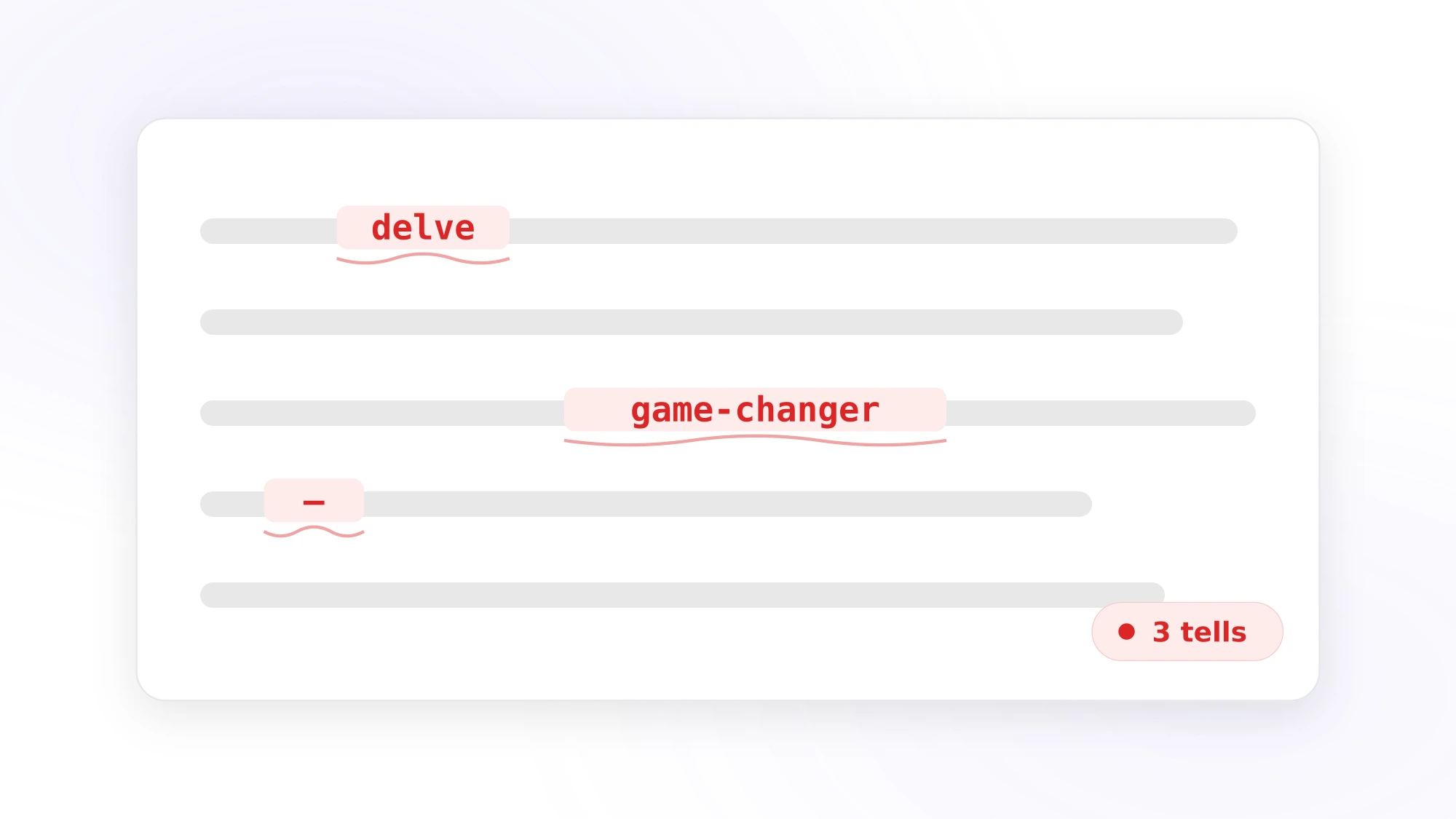
delve, tapestry, leverage, synergy, game-changer, seamless, robust, elevate, unlock, foster, realm, plethora, myriad, testament to, cutting-edge, best-in-class, navigate, landscape, and the evergreen "in today's fast-paced world."
The word that became a punchline is delve. It barely appeared in everyday business writing before late 2022, then its use spiked in lockstep with the arrival of mass-market chat assistants, and now it is the single word most likely to make a reader squint. Researchers who traced the spike have a few theories, from the writing in the training data to the preferences of the human raters who tuned the models. The cause is interesting. The lesson is simple: the words the model overuses are the words your reader has been trained to distrust.
The fix is simple. For each word, ask whether you would actually say it to a colleague over coffee. If the answer is no, it is padding, and padding is what makes writing sound generated.
The tells, engine by engine
Not every engine gives itself away the same way. If you paste from different tools, it helps to know each one's accent.
- The corporate-assistant cadence. The heaviest em-dash habit of the bunch, a fondness for the seesaw construction, and a warm, slightly over-eager closing line that asks if you would like it to continue. The most polished, and the most recognizable.
- The hedging accent. More cautious. It stacks caveats and softens claims with "it is worth noting" and "that said." The prose is careful to a fault, which on a feed reads as someone afraid to have an opinion.
- The structure-forward accent. It reaches for bold subheadings, numbered lists, and tidy little summaries even when the thought would have been better as two plain sentences. The shape gives it away before the words do.
The accents differ, but the underlying tell is the same in all three: the output is the average of everything written about your topic, and the average is exactly what a reader has learned to scroll past.
The AI-detector trap
Faced with all this, the obvious move is to paste your draft into an AI detector and trust the verdict. Do not. AI detectors are the least reliable part of this entire conversation, and the evidence against them is not a vibe, it is a stack of studies. (Yes, that was a seesaw, the exact move this post warns about. One on purpose, to make a point, is fine. The tell is the autopilot version, in every other line.)
Start with the companies that build the models. One of the largest of them launched its own AI-text classifier in early 2023 and quietly shut it down six months later, because it correctly flagged only about a quarter of AI-written text while mislabeling roughly one in eleven human passages as AI. If the maker of the model cannot reliably spot the model, a third-party score is not something to bet your reputation on.
Independent research is harsher. A widely cited 2023 study that tested fourteen detection tools concluded they are “neither accurate nor reliable,” with every tool falling well short of a dependable standard and a consistent bias toward labeling text as human. The same study found that a light paraphrase, or a round trip through a translator, collapses their accuracy further. The robotic posts you actually want to catch are the easiest ones to sneak past.
The false accusations are worse than the misses. A Stanford study found that detectors flagged a majority of essays by non-native English speakers as AI-written, while barely flagging native speakers at all, because the plain, predictable word choices these tools read as “machine” are simply how a lot of careful or second-language writers write. Detectors have also confidently labeled the US Constitution as AI-generated. A verdict that unreliable is not evidence of anything.
So here is the honest state of play: from the text alone, it is practically impossible to prove whether something was written by a person or a machine, and the tools that claim otherwise are mostly selling a confidence they have not earned. Take that as good news. Chasing a detector score is wasted effort, because the only judge that pays out is a human reader deciding whether to stop and read. Fix the patterns on this page, write for that reader, and the detector question takes care of itself.
Does the feed actually punish it?
Yes, though not in the way most people assume. In 2026 LinkedIn began actively limiting the reach of low-quality, generic AI content. But the platform does not need a magic AI detector to do it, because it reads something more honest than the text: behavior. Generic AI writing earns near-zero dwell time, no saves, and no real comments, and the ranker reads that flat signal and stops distributing the post. There is no warning label for sounding like AI. The penalty is quieter: reach that simply never arrives.
That connects this whole topic to the bigger machine. If you want the full picture of how the feed decides what travels in 2026, we wrote it up in the guide to the LinkedIn algorithm and why your reach is falling. And the flip side, the reason consistency beats cleverness, is in the essay on the 2% who actually publish. In 2026, sounding human is a distribution input in its own right, and it is also what gets you quoted: LinkedIn is one of the most-cited sources in AI search, and original, human-sounding writing is exactly what those engines pick up. If you are weighing tools on that exact axis, see how Blendin compares to Taplio on anti-AI writing.
How to make your writing sound human
Sounding human is mostly subtraction, plus a few specifics. A short checklist that fixes the bulk of it:
- Cut the long dashes. Replace each with a comma or a period. You lose nothing and you drop the most visible flag.
- Open with the point. Delete the announcement of the announcement. Start with the news, the number, or the opinion.
- Trade one abstraction for one detail. Swap "we drove significant impact" for "we cut their onboarding from nine days to two." One real number does more than a paragraph of adjectives.
- Vary the rhythm. Put a three-word sentence next to a twenty-word one. Read it aloud and listen for the metronome.
- Kill the buzzwords. If you would not say it out loud, cut it.
- Add one thing only you know. A detail from your actual week is the one input a model trained on everyone else's writing cannot reproduce.
Notice that none of this is about fooling a detector. The goal is simpler and older than any of this: sound like a person, because that is what earns a reader's trust, and trust is what the feed is now built to reward.
Check your draft in ten seconds
You do not have to hold all of this in your head. We built a free AI Writing Checker that does the scan for you. Paste a draft and it flags every tell on this page, the em dashes, the buzzword clusters, the hype openers, the emoji bullets, the hashtag walls, the flat rhythm, and gives you a plain human-ness score from 0 to 100 with a fix for each flag. There is a one-click button to clean up the obvious mechanical tells, and you can even paste a public LinkedIn post link to check a post straight from its URL. It runs in your browser, with no signup.
Frequently asked questions
Are AI detectors accurate? No. One major model maker's own detector correctly flagged only a small share of AI-written text before the company retired it in 2023, and an independent study of fourteen detection tools found none were accurate or reliable, with every tool falling well short of a dependable standard. A Stanford study also found detectors flagged a majority of non-native English speakers' essays as AI-written, and detectors have confidently labeled the US Constitution as AI-generated. Treat any detector score as unreliable.
Why do AI models use em dashes? Language models are trained to predict the next likely word, then tuned toward writing that feels polished, and the em dash is a polish mark: it adds a flourish or a contrast without starting a new sentence. Edited professional prose, the kind that fills their training data, uses it heavily, so models learned to reach for it. Published comparisons found a current-generation model producing em dashes at a markedly higher rate than humans writing the same kind of text.
Does using AI hurt my LinkedIn reach? Not the tool itself, but generic AI writing does. In 2026 LinkedIn began actively limiting the reach of low-quality, generic AI content, and it does this by reading behavior rather than running a detector: generic AI writing earns near-zero dwell time, no saves, and no real comments, and the ranker stops distributing a post with that flat signal. There is no visible warning label. The penalty is quieter: the reach simply never arrives.
How can I tell if something was written by AI? Look for tells that cluster rather than any single mark: a hype opener like thrilled to announce, the not just X, it is Y seesaw, emoji bullet lists, a hashtag wall, a flat metronome rhythm where every sentence runs the same length, the rule of three repeated, and essay glue words like moreover and furthermore. The deepest tell is abstraction where a specific should be: AI writes around a topic, while a person names the client, the number, and the date.
Is the em dash proof of AI writing? No, and treating it as one is a mistake. On its own, an em dash proves nothing: careful writers and editors have used it for a century, and some AI models barely use it at all. It became a tell for two reasons: most people never type a real em dash so AI's frequent use stands out, and readers now believe it is a tell, which taxes anyone whose post pattern matches what people have decided AI looks like. One long dash in a sharp, specific post is nothing; a long dash next to five other tells is a confession.
The bottom line
The em dash did not ruin your writing, and removing it will not save it. What reads as AI is the pattern: the canned opener, the seesaw, the triads, the buzzwords, the flat rhythm, and the absence of a single real detail. Fix the pattern and the writing sounds like you again, which is the only thing that was ever going to earn attention, and, in 2026, reach too. Run your next post through the AI Writing Checker before you publish, and let the score, not a single punctuation mark, be the judge.
Sources and further reading
- Every, “What the Em Dash Says About AI-assisted Writing and Us”: every.to.
- Sean Goedecke, “Why do AI models use so many em-dashes?”: seangoedecke.com.
- McGill Office for Science and Society, “Why Did LLMs Steal Our Em-Dashes?”: mcgill.ca.
- Social Media Today, “LinkedIn wants to limit the reach of AI-generated content”: socialmediatoday.com.
- TechCrunch, report on a major model maker retiring its AI-written text detector over a low rate of accuracy (2023): techcrunch.com.
- Weber-Wulff et al., “Testing of detection tools for AI-generated text,” International Journal for Educational Integrity (2023): link.springer.com.
- Stanford HAI, “AI Detectors Biased Against Non-Native English Writers”: hai.stanford.edu.