A capability statement is one page, and six blocks decide whether it works
It is the one page a government or enterprise buyer reads to decide whether you are worth a meeting. It is a convention rather than a form: nothing is filed anywhere, there is no mandated layout, and the whole thing is decided by what you put in six blocks.
Below: the layout, the six blocks with what belongs in each, the identifier fields and who issues them, the six things that get a sheet binned, the company profile a commercial buyer asks for instead, and two templates you can copy and fill in. You do not need an account for any of it.
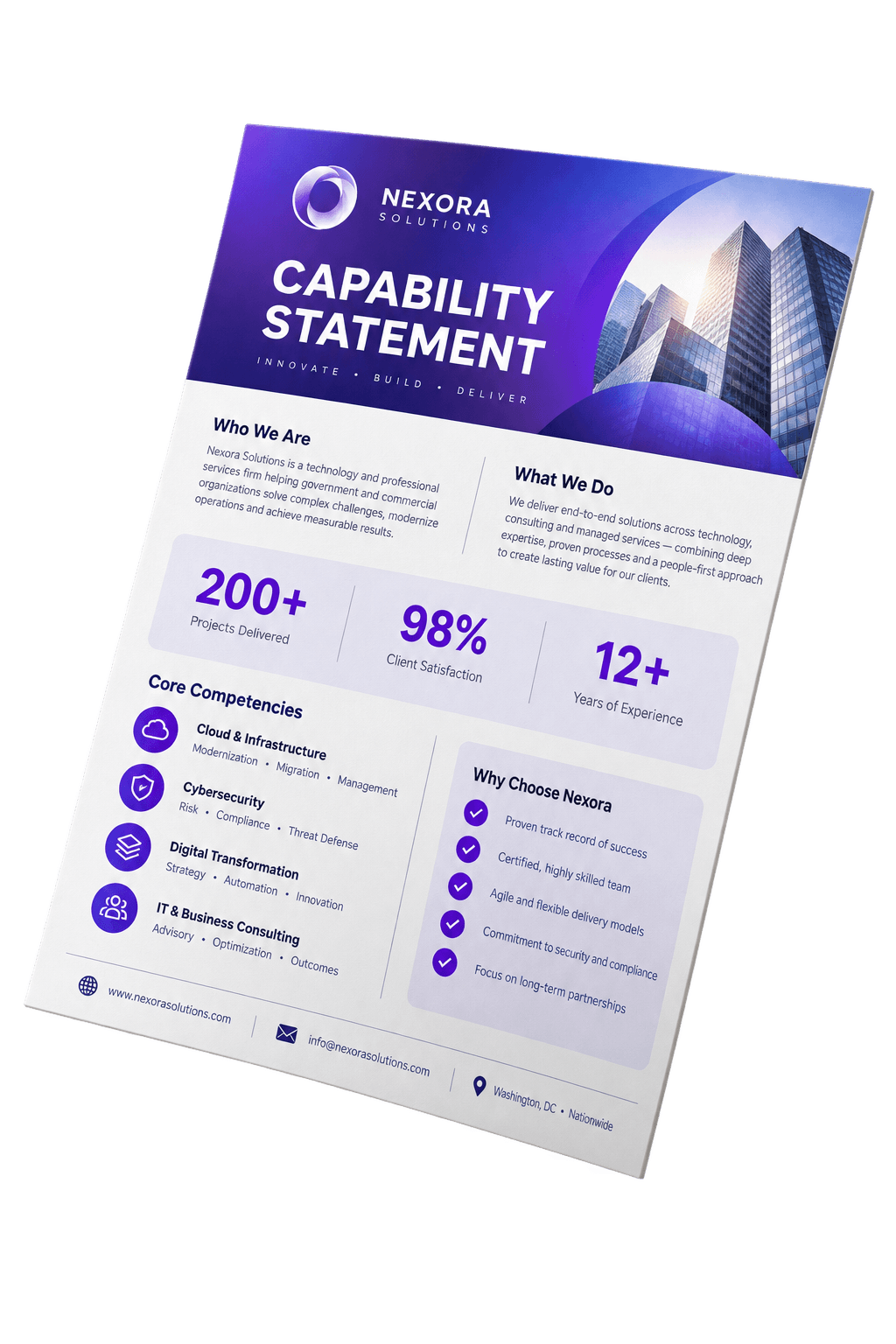
12
characters in a Unique Entity ID, issued inside SAM.gov
GSA
5
characters in a CAGE code, assigned through the same registration
Defense Logistics Agency
2022
the year the DUNS number stopped being the federal entity identifier
GSA, effective 4 April 2022
Three facts a contracting officer can check at the source, which is the only sort of number this page carries.
What is a capability statement?
A one page document that tells a government or enterprise buyer what your company does, what it has already delivered, why you rather than the next qualified bidder, and the identifiers they need to look you up. It is a convention rather than a form: nothing is filed anywhere, there is no mandated layout, and it is decided by what you put in six blocks.
- Length
- One page
- Blocks
- Six
- Filed with
- Nobody
- Rebuilt per approach
- Two blocks
What is a company profile, and is it the same document?
Almost. A company profile is the commercial version of the same page, and it differs in exactly one block: the federal identifiers become the things a vendor onboarding form asks for anyway, meaning trading history, headcount, service area, insurance limits, certifications and safety record. The overview, competencies, differentiators, past performance and named contact do not move.
- Blocks that differ
- One
- Also called
- Business one pager
- Length
- One page, same rule
- Reader
- Procurement or a facilities lead
The layout is the reason it never gets finished
Paste your website address and Blendin lays the sheet out in your firm's real colours, fonts and logo, as a PDF you can send or publish. You supply every fact on it.
Free for 14 days on the full Starter plan, card required, no charge today, then $59 a month, cancel anytime.
Narrative down the left, identifiers down the right, one contact at the foot
There is no official template, but a convention has settled and buyers now expect it. Following it is worth doing for a plain reason: a contracting officer reading twenty sheets knows exactly where to look, and a document they have to hunt through loses to one they do not.
The six blocks, and what each one is for
Each block answers one question the buyer is already asking. The length guide beside each is the convention, not a rule, and the failure line under each is the version that arrives most often.
01Company overview
Three to four lines. Never a paragraph.What you do, who you do it for, where you do it, and how long you have been doing it. The reader is deciding in seconds whether you are in the right business at the right size, so lead with the plain trade description rather than a mission. If you are a commercial janitorial contractor covering four counties with 60 staff, that sentence is the whole overview.
A mission statement. Nobody has ever shortlisted a vendor on a mission statement.
02Core competencies
Five to eight bullets, each a service, not an adjective.The specific work you want to be bought for, in the words the buyer uses in a solicitation rather than the words you use internally. Match the language of the code you are chasing. Cut anything you would not want to be called about, because this block is what gets you called about.
Adjectives. Customer focused, results driven, innovative and mission ready describe nobody, and a buyer reading twenty sheets sees the same eight words on all of them.
03Past performance
Three to five entries, one line each.Who the customer was, what you delivered, the period, the value, and a contact who will pick up the phone. Relevance beats size: a small job for the same agency, in the same code, is worth more here than a large one in an unrelated field. Put the most relevant entry first and rebuild the order for each approach.
A wall of client logos. A logo says you were in the building once. A line with a period, a value and a contact says you delivered.
04Differentiators
Three to five bullets. Three good ones beat five weak ones.The reason to pick you over the other qualified bidder, written so a competitor could not paste it onto their own sheet. A clearance level, a certification, a response time you contractually hold, a piece of equipment inside the region, a crew size you can put on site tomorrow, a system you are already accredited on. If your competitor could claim it word for word, it is not a differentiator.
Quality, integrity and competitive pricing. Every sheet in the stack claims all three.
05Company data and codes
A block of labelled fields. Right hand column.The identifiers a contracting officer uses to look you up, listed below field by field. This block is the difference between a document that can be acted on and one that has to be researched, and it is the block most often missing from a small business sheet.
No identifiers at all, which reads as not registered, or a DUNS number, which stopped being the federal identifier in 2022.
06One named contact
A name, a title, a direct line, a real inbox.One person who answers, with a direct number and an address that is not info@. A capability statement is often forwarded internally before anybody calls, so the contact travels with it and has to survive being read by a stranger three days later.
A general inbox and a switchboard number. Both read as an office that does not expect the call.
| Block | How long it runs |
|---|---|
| 01Company overview | Three to four lines. Never a paragraph. |
| 02Core competencies | Five to eight bullets, each a service, not an adjective. |
| 03Past performance | Three to five entries, one line each. |
| 04Differentiators | Three to five bullets. Three good ones beat five weak ones. |
| 05Company data and codes | A block of labelled fields. Right hand column. |
| 06One named contact | A name, a title, a direct line, a real inbox. |
A worked example, with the hard part filled in
The same six blocks written out for a facility services company. Read the competencies and the differentiators closely: they are the two blocks where most sheets fail.
Harbor Ridge Facility Services
Commercial janitorial and floor care
Capability statement
Company overview
Commercial janitorial, floor care and post construction cleaning for healthcare, education and light industrial sites across four counties. Directly employed crews, trading since [year], [n] staff, insured and bonded.
Core competencies
- Daily custodial services in occupied facilities
- Terminal and infection control cleaning to healthcare protocol
- Hard floor restoration, stripping, sealing and carpet care
- Post construction and final clean before handover
- Emergency and out of hours response
- Consumables and dispenser supply management
Differentiators
- Every site supervisor is directly employed, never subcontracted
- Out of hours response held contractually, from two depots inside the service area
- Clinical protocol training completed by all staff assigned to healthcare sites
- One named account manager for the life of the contract, named in the bid
Past performance
- [County school district] · nightly custodial, [n] sites, [n] sq ft · [dates] · [value] · [contact, phone]
- [Regional clinic group] · terminal clean and floor care · [dates] · [value] · [contact, phone]
- [General contractor] · post construction final cleans, [n] projects · [dates] · [value] · [contact, phone]
Company data
| UEI | [12 characters, from SAM.gov] |
|---|---|
| CAGE | [5 characters] |
| NAICS | 561720 primary, [secondary codes] |
| Set asides | [only what you actually hold] |
| Bonding | [single and aggregate] |
| Insurance | [GL, auto, workers comp limits] |
Contact
[Name], [Title]
[Direct line]
[Named inbox]
Why those two blocks work
Terminal and infection control cleaning to healthcare protocol is a thing a hospital procures, and quality cleaning solutions is not. Every differentiator under it fails the same test the other way round: a competitor could not paste one onto their own sheet without it becoming false, which is why there are four rather than eight.
The identifier block, field by field
Every field below names the body that issues it, so you can check the current requirement at the source rather than taking our word for it.
| UEIUnique Entity ID | A 12 character alphanumeric identifier issued inside SAM.gov as part of registration. It replaced the DUNS number as the federal entity identifier on 4 April 2022, per GSA. If your sheet still shows a DUNS number, that is the single fastest way to look out of date. |
|---|---|
| CAGECommercial and Government Entity code | A five character code assigned by the Defense Logistics Agency. Domestic entities are assigned one through the SAM.gov registration, at no charge. |
| NAICSIndustry classification codes | The North American Industry Classification System, maintained by the US Census Bureau. Your primary code is the one that determines which SBA size standard you are measured against. List the primary first and keep the list short enough to be believable. |
| Set asidesSocio economic certifications | Small business, and where they apply the SBA certified categories such as 8(a), HUBZone, WOSB and SDVOSB. Only claim a status you actually hold and can evidence, with the certifying body named. |
| VehiclesContract vehicles and schedules | Any GSA Schedule, IDIQ, BPA or state and local vehicle you are on. For a prime reading your sheet as a possible subcontractor, this is often the first line they look for. |
| BondingBonding, insurance and clearances | Single and aggregate bonding capacity for construction and facility work, insurance limits, and any facility or personnel clearance level. Omit the ones that do not apply to your trade rather than padding the block. |
Requirements change, and the issuing body named in each row is always more current than a page like this one. Check there before you print.
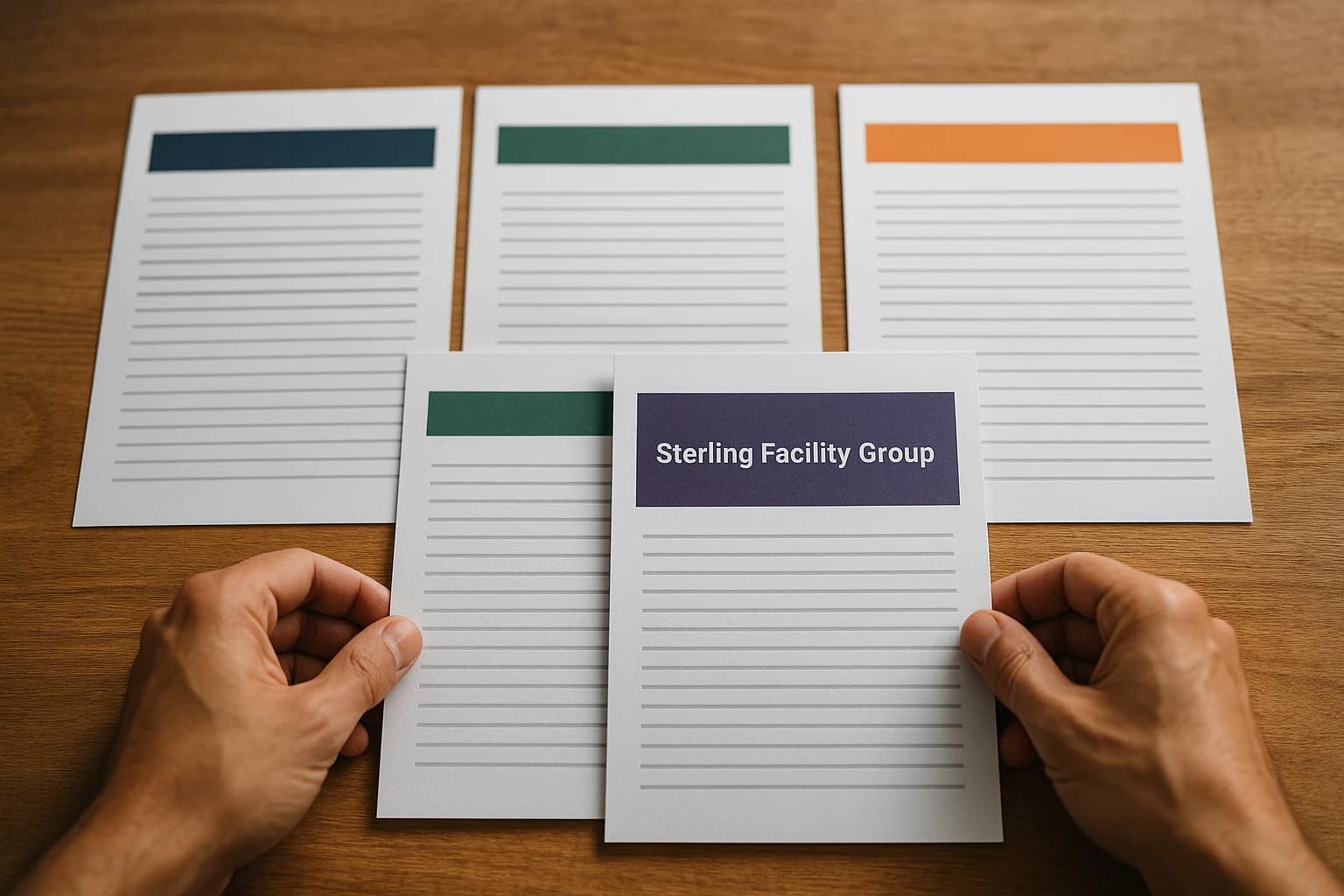
Yours is being read next to four other vendors'
A capability statement rarely gets read alone. It sits in a stack with everyone else being considered for the same opportunity, so the identifiers, the differentiators, and the one page limit are not stylistic choices. They are what survives the first pass.
Six things that get a capability statement binned
Almost every guide to this document lists the sections. Very few say what makes a complete one fail anyway, which is the part worth knowing, because a sheet with all six blocks can still be the weakest in the stack.
It runs to two pages
It is read in a stack, on a screen, next to nine others. The convention is one page because the second page is not opened. If the content genuinely will not fit, the differentiators are too long and the overview is a paragraph.
The same sheet went to every office
Contracting offices buy different things. The version you send to a facilities office and the version you send to an IT office should not share a competencies block, and reordering past performance for the office you are approaching takes four minutes.
The competencies are written for you, not for the buyer
Buyers search and skim in the vocabulary of the solicitation. If they are buying custodial services and your sheet says environmental hygiene solutions, you will not be found by a keyword search and you will not be recognised by a human either.
Past performance with nothing checkable in it
No period, no value, no contact. An entry a buyer cannot verify is decoration, and a stack of them makes the checkable ones look weaker by association.
It is a scan, or a 12 MB export
It gets emailed, forwarded and sometimes uploaded to a portal with a size limit. Text in a real PDF, under a couple of megabytes, is the format that survives all three. A photograph of a printout survives none of them.
The claim is bigger than the evidence
Nationwide coverage from one depot. A certification held by a teaming partner rather than by you. Government buyers verify, and a single claim that does not hold up costs you the sheet and usually the relationship.
Both templates, in plain text
Copy either into whatever you write in. They carry the field labels and the order, and nothing else, so they will not fight your own layout. The federal one is on the left, the commercial company profile on the right.
Capability statement
Plain text
CAPABILITY STATEMENT

[Company name]  |  [one line trade description]
[City, state]  |  [website]  |  [phone]

COMPANY OVERVIEW
[What you do, who for, where, and since when. Three to four lines.]

CORE COMPETENCIES
- [Service, in the buyer's words]
- [Service]
- [Service]
- [Service]
- [Service]

DIFFERENTIATORS
- [Something a competitor could not paste onto their own sheet]
- [Something measurable: a response time, a capacity, a clearance]
- [Something local, certified or accredited]

PAST PERFORMANCE
- [Customer] | [What you delivered] | [Period] | [Value] | [Contact name, phone]
- [Customer] | [What you delivered] | [Period] | [Value] | [Contact name, phone]
- [Customer] | [What you delivered] | [Period] | [Value] | [Contact name, phone]

COMPANY DATA
UEI: [12 characters, from SAM.gov]
CAGE: [5 characters]
NAICS: [primary first, then secondary codes]
Business size / set asides: [only what you hold]
Contract vehicles: [GSA Schedule, IDIQ, BPA, state vehicles]
Bonding / insurance / clearances: [where they apply]

POINT OF CONTACT
[Name], [Title]
[Direct phone]  |  [Named inbox, not info@]
Company profile
Plain text
COMPANY PROFILE

[Company name]  |  [one line trade description]
[City, state]  |  [website]  |  [phone]

WHO WE ARE
[What you do, who for, where, and since when. Three to four lines.]
[One clause naming the sectors you already serve.]

WHAT WE DO
- [Service, in the words your buyer uses]
- [Service]
- [Service]
- [Service]

WHY US
- [Something a competitor could not paste onto their own profile]
- [Something measurable: a response time, a capacity, an accreditation]
- [Something local, certified or long standing]

WORK LIKE YOURS
- [Customer] | [What you delivered] | [Period] | [Value] | [Contact name, phone]
- [Customer] | [What you delivered] | [Period] | [Value] | [Contact name, phone]

COMPANY DATA
Trading since: [year]        Headcount: [ ]
Service area: [ ]            Legal entity and registration: [ ]
Insurance: [GL, auto, workers comp limits]
Certifications and accreditations: [ ]
Safety record: [where the work is physical]

POINT OF CONTACT
[Name], [Title]
[Direct phone]  |  [Named inbox, not info@]
A capabilities deck is a different document
A slot that says ten minutes means seven once the introductions are done, which is why the deck is six to ten slides rather than twenty. The content is the same six blocks reordered around one buyer, and the two slides that decide whether anything happens afterwards are how to buy from us and what we are asking for.
A credentials deck and a capability briefing are the same object under different names, and a commercial buyer will usually call it a credentials deck. Blendin makes both shapes, portrait for the sheet and landscape for the deck.
1
Who we are
One slide. The same overview as the sheet, said out loud.
2
What we do, mapped to what you buy
Competencies rewritten against this office's actual requirements rather than your service list.
3
Work like yours
Two or three past jobs chosen because they resemble this buyer, with the outcome stated plainly.
4
Why us over the next bidder
The differentiators, with the evidence on the slide rather than in the talk.
5
How to buy from us
Vehicles, schedules, set asides and codes. This is the slide that turns interest into a route.
6
What we are asking for
One specific next step. A meeting that ends without one is a meeting you have to get again.
The company profile is the same page minus one block
A corporate procurement team running vendor onboarding, a facilities director consolidating suppliers and a prime screening subcontractors are all doing the same thing: deciding in one page whether you are worth a meeting. When one of them asks for a company profile, a business one pager or a company overview, they are asking for this page with the federal block swapped out.
Four differences, and one warning about the word
The identifier block becomes the onboarding block
Drop UEI, CAGE and set asides, which mean nothing to a private buyer, and replace them with what their vendor form is going to ask for anyway: years trading, headcount, service area, insurance limits, industry certifications, safety record where the work is physical, and the systems you are already accredited on.
Past performance can name names more easily
Commercial references are usually easier to get permission for than federal ones, and a buyer in the same sector recognises the names. Keep the period, the value and a contact who answers, because a reference nobody can call is decoration.
The overview earns one more line
A federal reader wants the trade description. A commercial reader also wants to know who you already do this for, so the overview can carry one clause naming the sector rather than the code.
One warning about the phrase one pager
In B2B services a one pager is this document. In startup and investor circles it usually means a fundraising summary carrying traction, market size and the ask, which is a different document with a different reader. If a buyer asks you for a one pager, send the company profile. If an investor does, they mean the other thing, and nothing on this page applies to it.
The company profile template is beside the capability statement one, which is where the difference between them is easiest to read.
How to write one in an afternoon
In this order, because the order is what stops it stalling. The identifiers are the only part you cannot write from memory, so they come first.
- 1
Pull your identifiers first
Open SAM.gov and copy your UEI, your CAGE code and your registered NAICS codes exactly as they appear. Note your primary code and the SBA size standard attached to it. Doing this first stops the document being blocked at the end by the one block you cannot write from memory.
- 2
Write the competencies in the buyer's vocabulary
Take the wording from a real solicitation or a sources sought notice for the work you want, and write five to eight competencies in that language. Cut every adjective. If a line does not name a service somebody buys, it is not a competency.
- 3
Pick three past performance entries and make them checkable
Choose relevance over size. Each entry carries the customer, what you delivered, the period, the value and a contact who will answer. If you cannot name the customer, describe them precisely and say so.
- 4
Cut the differentiators until a competitor could not copy them
Write five, then delete any a rival could paste onto their own sheet unchanged. Two or three that survive that test are worth more than five that do not.
- 5
Lay it out on one page, in your own brand
Company data down the right, narrative down the left, contact at the foot. In Blendin, paste your website address so the sheet comes out in your real colours, fonts and logo, then download the PDF or publish it as a LinkedIn document. Keep the source file, because you will rebuild two blocks for every serious approach.
Twenty questions about these two documents, answered in one line
Each row is a separate question, with its own link. If one of them is the reason you are here, take the answer and go.
| The question | The short answer |
|---|---|
| What is a capability statement? | A one page document telling a buyer what you do, what you have delivered, why you over the next bidder, and the codes to look you up. |
| How long should a capability statement be? | One page. It is read in a stack on a screen and the second page is not opened. |
| Is it capability statement or capabilities statement? | Both spellings are in common use, including by federal offices. Pick one and be consistent. |
| Do I need a UEI to have one? | For a federal approach, in practice yes, because the first thing a contracting officer does is look you up.The Unique Entity ID is issued inside SAM.gov as part of registration. |
| What replaced the DUNS number? | The Unique Entity ID, from 4 April 2022 per GSA. A sheet still showing a DUNS number reads as out of date. |
| How do I get a CAGE code? | Domestic entities are assigned one through the SAM.gov registration, at no charge, by the Defense Logistics Agency. |
| How many NAICS codes should I list? | Enough to cover what you actually do and no more. Fifteen tells a buyer you are guessing.Your primary code is what your SBA size standard is measured against. |
| Is a capability statement required to bid? | It is not a federal form and is not submitted with a bid. It is what the informal round before the bid asks for. |
| Can I use the same one for every agency? | You can, and it is the most common reason a sheet does nothing. Rebuild two blocks per approach: competencies and the order of past performance. |
| What is a company profile? | The commercial version of the same page: who you are, what you do, why you, who you have done it for, and the data a vendor form asks for. |
| What is the difference between a company profile and a capability statement? | One block. The federal identifiers become trading history, headcount, service area, insurance and certifications. |
| What is a business one pager? | The same document under a plainer name. If a buyer asks for one, send the company profile and do not rename anything. |
| How long should a company profile be? | One page, for exactly the same reason. A multi page version is a brochure and is read as one. |
| What goes in a company overview? | What you do, who for, where, since when, and one clause naming the sectors you already serve. Three to four lines.Never a mission statement. Nobody has shortlisted a vendor on one. |
| What is a capabilities deck? | Six to ten landscape slides you present inside a meeting, where the one page sheet is what got you the meeting. |
| Is a credentials deck the same as a capabilities deck? | Yes. Commercial buyers tend to say credentials deck and federal ones capability briefing. |
| What is past performance? | Three to five entries, one line each, carrying the customer, what you delivered, the period, the value and a contact who answers. |
| What counts as a real differentiator? | Anything a competitor could not paste onto their own sheet without it becoming false. If they could, it is not one. |
| Can I write one without any government experience? | Yes. Past performance can be commercial work, described precisely. An empty block is worse than a commercial one. |
| Does it need to be designed? | It needs to be legible, one page, and a real PDF under a couple of megabytes. A scan or a 12 MB export fails on the portal. |
Where Blendin fits, and where it does not
The hard part of this document is the thinking, and no tool does that for you. What a tool can do is stop the layout being the reason it never gets finished.
What it does
- Lays the document out and gives you the PDF, to download and send or to publish as a native LinkedIn document post.
- Lets you move text, shapes, images and your logo by hand on the finished page, which is free on every plan.
- Writes in the way your own site already writes, rather than in the voice every content tool defaults to.
- Keeps the brand for everything else you publish, so the sheet and the feed match instead of being two different companies.
What it will not do
The fabrication ban applies here more than anywhere else on this site, because this is the document a contracting officer verifies before they call you.
- It will not invent a code, a certification, a contract value, a client name or a past performance contact. You supply every fact.
- It will not register you in SAM.gov, look up your UEI, or tell you which NAICS code to claim.
- It will not decide your differentiators. It lays out the three you give it and does not pad them to five.
- It does not replace a proposal writer on a bid that is genuinely worth hiring one for. This is the page that gets you into the room.
- It does not track opportunities, watch solicitations, or tell you which office to approach.
How it is charged, plainly: a document is not sold separately and there is no extra purchase for it. It draws on the same monthly allowance as everything else you make, counted by the pages it generates, on plans at 59, 139 and 249 dollars a month.
Questions
What is a capability statement?
A capability statement is a one page document that tells a government or enterprise buyer what your company does, what it has already delivered, why you rather than the next qualified bidder, and the identifiers they need to look you up and buy from you. It is the standard introduction in United States government contracting, and it is used the same way by primes screening subcontractors and by large private buyers running vendor onboarding. It is a sales document with a procurement convention, not a form: nothing is filed anywhere and there is no single mandated layout.
Is a capability statement the same as a capabilities statement?
Yes. Both spellings are in common use, including by federal offices, and no buyer will treat one as wrong. Pick one and be consistent inside your own document.
How long should a capability statement be?
One page. It is read on a screen, in a stack, alongside other vendors, and the second page is reliably not opened. If it will not fit, the fix is almost always the same two things: the company overview has become a paragraph, and the differentiators are being explained rather than stated.
What goes on a capability statement?
Six blocks. A company overview of three to four lines, five to eight core competencies written as services rather than adjectives, three to five past performance entries carrying a period, a value and a contact, three to five real differentiators, a company data block with your UEI, CAGE code, NAICS codes, any set aside certifications, contract vehicles and bonding or insurance where they apply, and one named person with a direct line.
Do I need a UEI and a CAGE code to have one?
For a federal approach, yes in practice, because the first thing a contracting officer does is look you up. The Unique Entity ID is a 12 character identifier issued inside SAM.gov as part of registration and it replaced the DUNS number on 4 April 2022 per GSA. The CAGE code is a five character code assigned by the Defense Logistics Agency and domestic entities receive one through the same SAM.gov registration at no charge. For a commercial buyer neither is relevant, and that block becomes certifications, insurance limits and trading history instead.
How many NAICS codes should I list?
Enough to cover what you actually do and no more. NAICS is maintained by the US Census Bureau and your primary code is what your SBA size standard is measured against, so it is the one that decides whether you count as small for a given opportunity. A sheet listing fifteen codes tells a buyer you are guessing at what they want to hear.
Is a capability statement required to bid?
It is not a required federal form and it is not submitted with a bid. What happens in practice is that market research notices, sources sought responses, small business office meetings, matchmaking events and prime subcontractor screens all ask for one, so a company without a current sheet loses the informal round that decides who gets invited. That is why it is worth having before you need it rather than the week a solicitation drops.
Can I use the same capability statement for every agency?
You can, and it is the most common reason a sheet does nothing. Two blocks are worth rebuilding for each approach, and both take minutes: reorder past performance so the most relevant entry is first, and rewrite the competencies in the vocabulary of the office you are approaching. Everything else can stay fixed.
What is the difference between a capability statement and a capabilities deck?
The one page statement gets you the meeting and the deck is what you present inside it. The statement is skimmed, forwarded and filed by somebody deciding whether you are worth an introduction, so it is dense and complete. The deck is six to ten landscape slides for a slot that is usually shorter than it says, so it is the same material reordered around one buyer, with two slides doing most of the work: how to buy from us, and what we are asking for. A credentials deck and a capability briefing are the same object under different names, and commercial buyers tend to use the first.
Is there a capability statement sample I can work from?
There is one on this page, written out for a facility services company. The written fields are filled in, because that is the part nobody can produce from a blank page, and the figures, codes and contacts are left in brackets, because those are yours and a sample that invents them teaches the wrong habit on a document a buyer verifies. Read the competencies and the differentiators first: those two blocks are where almost every sheet is won or lost.
What is the difference between a company profile and a capability statement?
One block, and the rest is the same document. A capability statement is written for a federal or prime buyer and carries the identifiers they use to look you up: UEI, CAGE, NAICS codes and any set aside certifications. A company profile is written for a commercial buyer, who has no use for any of that, so the same block becomes the things their vendor onboarding form is going to ask for anyway: years trading, headcount, service area, insurance limits, industry certifications, safety record where the work is physical, and the accreditations you already hold. The overview, the competencies, the differentiators, the past performance and the one named contact do not move, and neither does the one page discipline.
What is a business one pager, and is it the same thing?
In B2B services, yes. A business one pager, a company profile, a company overview document and a corporate one pager are four names for the page a buyer asks for when they are deciding whether you are worth a meeting. If somebody asks you for a one pager, send the company profile and do not rename anything. The word travels further in startup and investor circles, where a one pager usually means a fundraising summary carrying traction, market and the ask, which is a different document with a different reader and is not what this page is about.
What goes in a company profile?
Six blocks in the same order as the capability statement. Who you are in three to four lines, including one clause naming the sectors you already serve. Four to eight services written in the words your buyer uses. Three to five differentiators a competitor could not paste onto their own page. Two or three pieces of relevant work with the period, the value and a contact who answers. A company data block carrying trading history, headcount, service area, legal entity, insurance limits, certifications and safety record. And one named person with a direct line. A copyable template is on this page.
What does Blendin do with a capability statement?
It builds the document in your own brand. You paste your website address, it reads the real colours, fonts and logo off your own pages, and it lays the sheet out as a PDF you can download and send or publish as a LinkedIn document post. It will not invent a code, a certification, a contract value or a client name: you supply every fact, which is the only way a document a contracting officer verifies is safe to generate at all.
Paste the company URL and the brand comes back
Blendin reads the real colours, fonts, logo and tone off your own site and carries them onto the capability statement, the company profile, and everything else you publish. It never invents a brand colour that is not there, which is the same rule this whole page runs on: real signal or nothing.
The rest of the documents a services company owes itself
Pricing the work you were shortlisted for
The proposal, the job bid and the rate sheet. Service proposal template.
The proof that shortens the next one
The eight parts and a copyable template on the case study page.
The product facing pair, and everything else
Technical fact versus sales argument on the spec sheet page, every template on the hub, and the plans.
Build it in your own brand
Paste your website address. Blendin reads the real colours, fonts and logo off your own pages and lays the sheet out in them. Free for 14 days on the full Starter plan, card required, no charge today, then 59 dollars a month, cancel anytime.
Start the free trial