A service proposal has eight sections, and buyers read them backwards
Almost everyone opens at the price, so the document has to survive being read out of order. The section that decides whether the rest is read at all is the first one, what you understood about their situation, and the section that protects your margin is the one almost nobody writes, what is not in scope.
This page covers the three documents you send before the work starts: the proposal you write when you defined the scope, the bid you send when somebody else defined it, and the rate sheet that answers the price question before the call. Each one laid out, each with a template you can copy. The fourth document in the set, the case study, is the one you write after, and it lives on its own page.
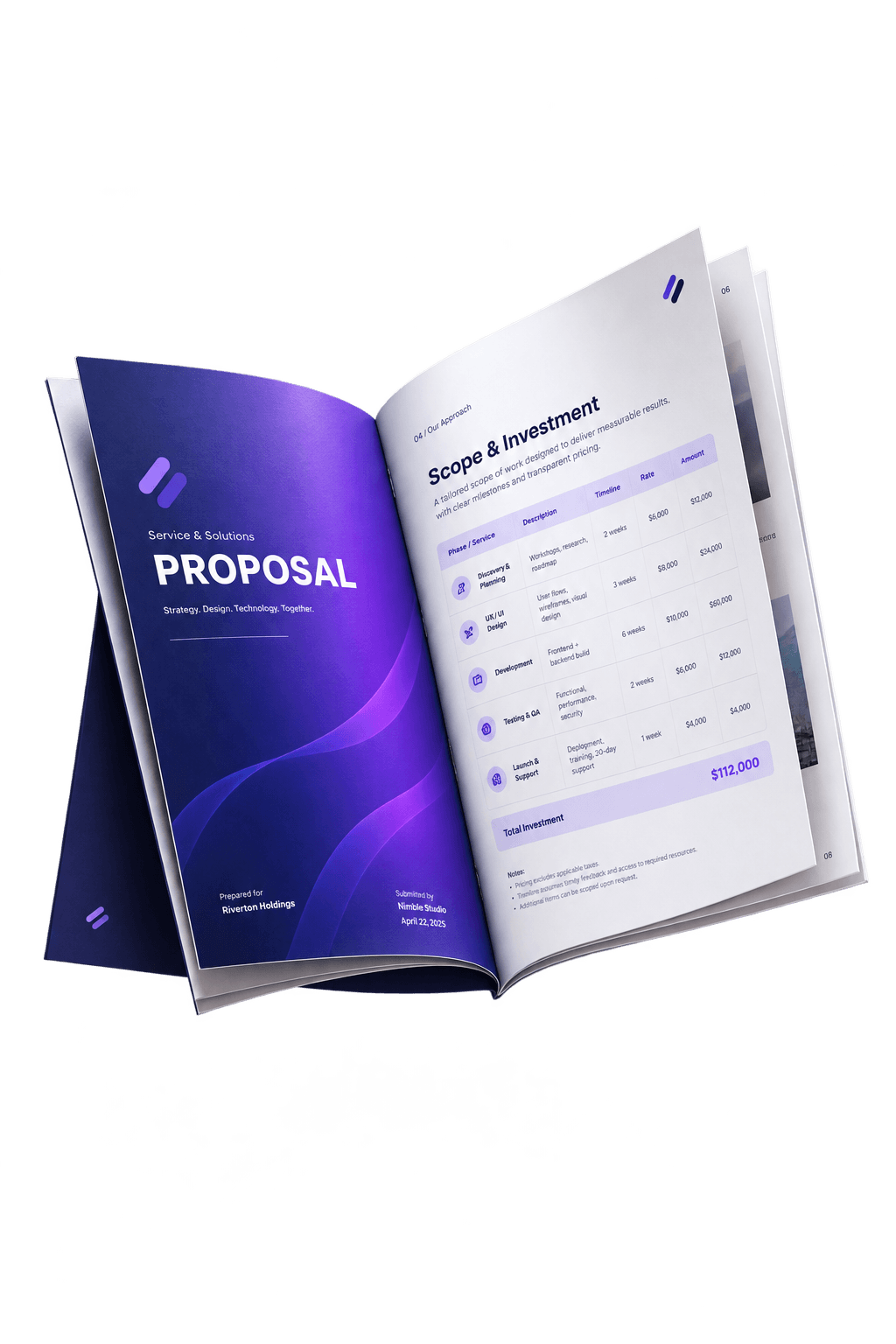
What should a service proposal include?
Eight sections, in this order: what you understood about their situation, what is in scope, what is not in scope, how the work runs and who does it, the timeline and what you need from them, the price and what triggers a change, one relevant piece of proof, and one next step with a validity date. Nothing about your company appears above the section proving you understood theirs.
- Sections
- Eight
- Length
- Two to five pages
- Read first
- The price
- Most often missing
- What is not in scope
Is a job bid the same as a service proposal?
No, and a generic proposal template fails on a bid for that reason. In a proposal you define the work as well as price it. In a bid somebody else defined it, and you are one of three or four numbers on a desk, so the sections that decide it are the drawing revision you priced, itemised inclusions and exclusions, allowances, alternates, schedule dependencies and the terms.
- Who wrote the scope
- They did
- What decides it
- Price, inclusions, schedule
- The section that saves you
- Exclusions
- Terms are
- Part of the price
Blendin lays out the proposal and the proof
Give it your scope, dates and price and it lays the proposal out in your real colours, fonts and logo. The case study it cites is the half most companies never get to, and Blendin builds that in the same brand.
Free for 14 days on the full Starter plan, card required, no charge today, then $59 a month, cancel anytime.
Which of the three you are actually writing
They get called proposals interchangeably and they share almost no sections, which is why a generic proposal template fails on a job bid and a bid template reads as evasive on a retainer. Two minutes here saves a rewrite.
A service proposal
You wrote the scope, and the work is ongoing or repeatable
A retainer, a managed service, a consulting engagement, a cleaning or maintenance contract. You are defining the work as well as pricing it, so the document has to make the shape of the engagement obvious before it makes the price obvious.
A job bid
Somebody else wrote the scope, and you are pricing it
A replacement, an installation, a build. The scope arrived as a drawing, a specification or a walkthrough, and you are one of three or four numbers on a desk. The sections that decide it are inclusions, exclusions and how long the price stands.
A rate sheet
You want the price question answered before the call
A published list of what you charge, by hour, by unit, by service or by tier. It filters buyers before they take your time, and it commits you in public, which is exactly why it is worth thinking about before you publish one.
| Feature | Service proposal | Job bid | Rate sheet |
|---|---|---|---|
| Who wrote the scope | You did | They did, or their engineer did | There is no scope yet |
| Who reads it | The buyer, then whoever signs | A GC, an estimator, a facilities lead | A stranger, before they call |
| What decides it | Whether you understood the problem | Price, inclusions and schedule | Whether the number is believable |
| The section that matters most | What is not in scope | Exclusions and allowances | What each rate includes |
| Is it published | No | No | Yes |
| Typical length | Two to five pages | One to three pages | One page |
| Carries a validity date | Yes | Yes | Yes |
| Carries a change order rateOn a bid it is part of the price rather than boilerplate. | Yes | Yes | No |
| Written once, or per job | Per job, from a fixed skeleton | Per job, always | Once, reissued with a date |
Trade convention across B2B services and the building trades, stated as convention rather than as data.
Eight sections, and almost every reader opens at the sixth
The order below is the order it is written in, and it is not the order it is read in. A proposal has to survive being read backwards from the price, which is why the figure that follows it, the proof, is the one that decides whether the number looks reasonable.
The service proposal, section by section
The label beside each says how it is really treated by somebody who has ten minutes and three proposals, which is different from how most templates assume it will be treated.
01What you understood
Read closelyTheir situation in their words, in three or four lines, before you say anything about yourself. This is the section that decides whether the rest is read, because a buyer is checking one thing first: did this person actually listen. Quote something they said in the meeting.
02What is in scope
Read closelyThe work, in the units the work is really done in. Sites, users, visits, hours, deliverables, response times. Vague scope is the single most expensive thing in this document, because it gets resolved later, in your time, at your cost.
03What is not in scope
Read closelyThe list almost nobody writes and every experienced buyer looks for. It is not defensive, it is clarifying, and it is the section that stops the project you priced becoming the project you delivered.
04How it runs, and who does it
SkimmedThe rhythm of the engagement and the names of the people. Who is on site, who answers the phone, who they escalate to. Buyers assume the person in the meeting is the person doing the work, so if that is not true, say so here rather than on day one.
05Timeline and what you need from them
Read closelyDates, and the dependencies on their side that move those dates. Access, approvals, a decision, an existing supplier finishing. Naming their obligations in the proposal is what makes a slipped date a shared problem rather than your failure.
06The price, and what it is priced against
Read firstAlmost every reader opens here, so make it survive being read out of order. State the figure, the billing rhythm, what triggers a change, and what your rate is when it does. If there are options, show two or three, never seven.
07Proof that you have done this before
SkimmedOne relevant case, not a client logo wall. This is where the case study you wrote after the last job does its work, and it is the reason the two documents belong to one routine even though they live on two pages.
08What happens next
Read closelyOne clear step, a validity date on the price, and how to accept. A proposal that ends without an instruction gets forwarded, and forwarded proposals stall.
Read closely, on the left. Skipped, on the right. And read out of order.
Two things this page argues rather than just states. Which of the eight sections gets read closely and which gets skipped, and the order they are actually read in, price first.
The document ends in a handshake, not a file
Every section in a proposal exists to get to this moment faster: the scope that sets expectations, the price that is read first, the exclusions that protect the margin. The proposal that works is the one that gets signed quickly.

What buyers skip, every time
None of these is wrong to include. What is wrong is where they usually sit, which is above the sections a buyer came for.
The company history
Founded in, a team of, our values. It goes first in most proposals and it is read last, if at all. If it earns a place at all it is one line, and it belongs near the proof rather than at the front.
The methodology diagram
Discover, define, deliver, in five circles. Every proposal in the stack has one and they are interchangeable, which is exactly why none of them is persuasive. What a buyer wants from this section is what happens in week one.
The terms appendix, until legal opens it
Keep it, because you will need it. Move it behind the signature so it does not sit between the price and the decision, and never let it be the reason the document is 30 pages.
Anything about you before anything about them
The rule the whole document obeys: nothing about your company appears above the section proving you understood theirs.
The out of scope list is the most valuable section in the document
It is also the one most often missing. The work you did not price is the work that eats the margin, and without this list it gets resolved on the job instead of in the document, in your time and at your cost. Writing it down is not defensive. It is the clearest signal in the whole proposal that you have done this before, and an experienced buyer reads its absence as an answer.
Bidding a job is a different document
If you install, replace or build, most of what a services proposal template gives you is wrong for you. Somebody else wrote the scope, your price sits next to two or three others, and the sections that decide the outcome are the ones a generic template does not have. This is the shape that works for a mechanical, electrical, HVAC or general contracting bid.
The scope you are pricing, restated
Name the drawing, revision, specification section or walkthrough date the price is based on. When a scope changes mid job, and it will, this line is the whole argument for a change order.
Inclusions, itemised
Equipment and models, materials, labour, crane or lift, permits, disposal, commissioning, start up, and the warranty term. Itemised means a buyer comparing three bids can see why yours differs rather than assuming it is markup.
Exclusions, itemised
Electrical beyond a stated point, structural work, asbestos or hazardous handling, patching and painting, after hours access, temporary heat or power, anything behind a wall nobody has opened. An unstated exclusion becomes an argument on the job.
Allowances and unit prices
For the parts nobody can see yet. State the allowance, what it covers, and the unit rate if it runs over. This is how a bid stays honest without being padded.
Alternates and options
Priced separately so they can be accepted or dropped without repricing the base. Two alternates is useful, six is a way of avoiding a recommendation.
Schedule, and what it depends on
Lead time on the long pole item, duration on site, and the access, approval or preceding trade the start date depends on. A schedule with no dependencies named is a schedule you will be blamed for.
The terms that protect the number
How long the price stands, what happens if material prices move, the change order rate, payment terms and retention. On a bid these are not boilerplate, they are the price.
One thing worth stating plainly, because it is the difference between a bid that holds and one that is argued about in month three: on a job bid the terms are not boilerplate. How long the price stands, what happens if material prices move, the change order rate and the retention are part of the number, and a buyer comparing three bids without them is comparing three different things.
The rate sheet, and whether to publish one
A rate sheet here means a services company publishing what it charges. The phrase is used for other things in other industries, including mortgage pricing and staffing, and none of that is what this section is about. For a services company it is a list of your units and your rates, and it does two jobs: it filters buyers before they take your time, and it commits you in public.
Rate sheet
Issued [date] · holds until [date]
| Service or role | Rate | What it includes |
|---|---|---|
| [Service or role] | per [unit] | includes [ ] |
| [Service or role] | per [unit] | includes [ ] |
| [Service or role] | per [unit] | includes [ ] |
Minimums
Out of hours and travel
Quoted, not listed
What goes on it
- What the unit is: hour, visit, site, user, device, square foot, ticket, month
- The rate, and whether it is a from price or a fixed one
- What the rate includes, in one line each
- Minimums: minimum call out, minimum engagement, minimum term
- Out of hours, weekend, emergency and travel, priced separately
- Volume or term breaks, if you genuinely offer them
- What is quoted rather than listed, and why
- The date the sheet was issued, and how long it stands
Publish them when the work is standard
A published rate saves you the calls that were never going to close and shortens the ones that were. It also stops you being the vendor who will not answer a simple question.
Publish them when you are not the cheapest
A price a buyer meets on the page, with what it includes beside it, is a price they can talk themselves into. The same number arriving in week three, after two meetings, reads as a surprise.
Do not publish them when every job is different
A rate sheet on genuinely bespoke work becomes an anchor you spend every proposal arguing against. Publish the units and the minimums, and mark the rest as quoted, which is honest rather than evasive.
Do not publish a rate you are already discounting
A buyer who finds that out treats every other number you give them the same way. Publish the one you would defend.
All three templates, in plain text
Headings and field labels, nothing else. The case study template is on its own page.
Service proposal template
Two to five pages, typically
SERVICE PROPOSAL

Prepared for [company], [name, role]
[Date]      Valid until: [date]

WHAT WE UNDERSTOOD
[Their situation, in their words. Three or four lines. Quote them.]

WHAT IS IN SCOPE
- [Deliverable or service, in the unit the work is really done in]
- [Deliverable or service]
- [Deliverable or service]
Response or service levels: [ ]

WHAT IS NOT IN SCOPE
- [The thing they might assume is included and is not]
- [The thing that becomes a change order]
- [The thing another supplier handles]

HOW IT RUNS
Rhythm: [visits, sprints, reporting, review cadence]
Who does the work: [names and roles, not just the company]
Who they contact, and who that escalates to: [ ]

TIMELINE
[Milestone] . [date]
[Milestone] . [date]
What we need from you, and by when: [access, approvals, decisions]

PRICE
[Figure]  |  [billing rhythm]  |  [term]
What triggers a change, and the rate when it does: [ ]
Options: [two or three, never seven]

PROOF
[One relevant case, one paragraph, with the outcome]

NEXT STEP
[One instruction, and how to accept]
Job bid template
One to three pages, typically
PROPOSAL AND BID

[Company]  |  [Project]  |  [Site address]
Bid date: [ ]     Price valid until: [ ]

SCOPE PRICED
Based on: [drawing no. and revision / specification section / walkthrough date]

INCLUSIONS
- Equipment: [make, model, capacity]
- Materials: [ ]
- Labour: [crew, hours or duration]
- Access equipment: [lift, crane, scaffold]
- Permits and inspections: [ ]
- Removal and disposal: [ ]
- Start up, commissioning and handover: [ ]
- Warranty: [term, parts and labour]

EXCLUSIONS
- [Electrical beyond the stated point]
- [Structural, patching, painting]
- [Hazardous material handling]
- [After hours or restricted access]
- [Temporary power, heat or water]

ALLOWANCES AND UNIT PRICES
[Item]: allowance [ ], covering [ ], unit rate over allowance [ ]

ALTERNATES
Alternate 1: [scope] . [add or deduct]
Alternate 2: [scope] . [add or deduct]

SCHEDULE
Lead time on [long pole item]: [ ]
Duration on site: [ ]
Depends on: [access, approvals, preceding trade]

TERMS
Price validity: [ ]     Material escalation: [ ]
Change order rate: [ ]  Payment terms: [ ]  Retention: [ ]
Rate sheet template
One page, typically
RATE SHEET

[Company]      Issued: [date]      Rates hold until: [date]

STANDARD RATES
[Service or role] . [rate] per [unit] . includes [ ]
[Service or role] . [rate] per [unit] . includes [ ]
[Service or role] . [rate] per [unit] . includes [ ]

MINIMUMS
Minimum call out: [ ]
Minimum engagement or term: [ ]

OUT OF HOURS AND TRAVEL
Evenings and weekends: [ ]
Emergency response: [ ]
Travel beyond [radius]: [ ]

BREAKS
[Volume or term]: [ ]

QUOTED, NOT LISTED
[The work that genuinely varies, and one line saying why]

Contact: [name, direct line, named inbox]
How to write one, in order
- 1
Decide which of the three documents you are writing
If you wrote the scope, it is a service proposal. If somebody else wrote it and you are pricing it, it is a bid. If you want the price question answered before the call, it is a rate sheet. They share almost no sections, so choosing wrong costs you a rewrite.
- 2
Write what you understood before you write anything about yourself
Three or four lines in their words, quoting something they actually said. Nothing about your company goes above this section. If you cannot write it, you do not yet have enough to send a proposal and the honest move is one more call.
- 3
Write the out of scope list before the price
List what a reasonable person might assume is included and is not. Do it before pricing, because the list changes the number, and doing it afterwards is how a proposal gets sent that you cannot deliver at the price on it.
- 4
Put the price where it can be found in under a minute
State the figure, the billing rhythm, what triggers a change and the rate when it does, plus a validity date. Move the terms behind the signature. Offer two or three options, never seven.
- 5
Attach one piece of proof, and write the next one when the job ends
The proof section is a single relevant case rather than a logo wall, and the cheapest way to always have one is to write up each finished job in the week it ends. That is what makes the next proposal shorter.
Twenty proposal and pricing questions, answered in one line
Each row is a separate question, with its own link. If one of them is the reason you are here, take the answer and go.
| The question | The short answer |
|---|---|
| What should a service proposal include? | Eight sections: what you understood, in scope, out of scope, how it runs, timeline, price, one proof, and the next step.In that order. Nothing about your company appears above the section proving you understood theirs. |
| How long should a service proposal be? | Two to five pages, with the price reachable in under a minute.Terms go behind the signature, never between the price and the decision. |
| What do buyers read first in a proposal? | The price, and usually out of order. Then scope, exclusions, timeline, then who does the work. |
| What is a scope of work? | The list of what you will do, written in the units the work is really done in: sites, visits, users, hours, deliverables.A scope written in adjectives instead of units is the most expensive sentence in the document. |
| Why does an out of scope list matter? | Because the work you did not price gets resolved on the job instead of in the document, in your time.Experienced buyers look for it, and they read its absence as an answer. |
| Is a bid the same as a proposal? | No. In a proposal you define the work as well as price it. In a bid, somebody else defined it and you are one of three numbers. |
| What goes in a construction or trade bid? | The scope priced, itemised inclusions and exclusions, allowances with unit rates, alternates, schedule dependencies, and the terms.Same shape for mechanical, electrical, HVAC and general contracting. |
| What are allowances in a bid? | A stated sum for work nobody can see yet, with what it covers and the unit rate if it runs over.It is how a bid stays honest without being padded. |
| What should an HVAC proposal include? | Equipment make, model and capacity, the electrical point you stop at, permits, disposal, commissioning, the warranty term and the price validity. |
| How long should a bid price stand? | State a date. Thirty days is common where material prices move, longer where they do not, and never leave it unsaid.Add what happens if material prices move before acceptance. |
| What is a change order rate? | The hourly or unit rate you charge for work outside the priced scope, agreed in the document rather than in the argument. |
| What is a rate sheet? | A published list of what a services company charges, by hour, visit, site, user, device or month, with what each rate includes.The phrase means other things in mortgages, staffing and music; this is the services sense. |
| What goes on a rate sheet? | The unit, the rate, what it includes, your minimums, out of hours and travel, any real breaks, what is quoted, and the issue date. |
| Should I publish my rates? | Publish when the work is standard and when you are not the cheapest. Do not publish on bespoke work or a rate you already discount. |
| What is the difference between a rate sheet and a rate card? | Nothing meaningful in services. Rate card is more common in media and advertising, rate sheet in trades and professional services. |
| How many pricing options should a proposal have? | Two or three. More than three is a way of avoiding a recommendation. |
| Should a proposal include references? | One relevant case, not a logo wall. A named period, a value and a contact who answers beats six recognisable marks. |
| Do I need a proposal for a repeat client? | A short one. The out of scope list and the validity date are the two sections worth keeping even when the relationship is settled. |
| Who should sign a proposal? | Whoever can approve the spend, named in the document. A proposal addressed to nobody in particular gets forwarded and stalls. |
| What is a capability statement, and how is it different? | The one page you send before a proposal exists, to be shortlisted at all. A proposal prices work you have already been invited to quote. |
Where Blendin fits, and where it does not
Of the three documents on this page, Blendin lays out one: the service proposal, from the scope, dates and price you give it. The bid and the rate sheet stay in whatever your business already runs on. It also makes the published half of the same job: the proof a buyer finds before they ask you to quote, and the case study your proposal cites.
The published half
- Reads your website and builds the brand from the real colours, fonts and logo already on your own pages.
- Turns a finished job into a case study you can attach to the next proposal, or publish as a native LinkedIn document that is swiped in the feed.
- Builds the capability statement that gets you shortlisted before a proposal exists.
- Keeps the same brand across everything you publish, so a buyer checking you out sees one company.
What it will not do
Stated plainly, because a page that pretends its product covers every document on it is a page nobody cites.
- Blendin lays a service proposal out from the scope, dates and price you give it, but it does not set your price or negotiate it. The number and the terms stay yours.
- It does not hold a rate card, calculate a bid, or track a change order.
- It will not invent a figure, a client name or an outcome for the proof section. You supply every fact.
- It does not replace a proposal writer on a bid that is genuinely worth hiring one for.
- It is a document you send, not a system of record: there is no e-signature, no acceptance tracking and no CRM behind it.
How it is charged, plainly: a document is not sold separately and there is no extra purchase for it. It draws on the same monthly allowance as everything else you make, counted by the pages it generates, on plans at 59, 139 and 249 dollars a month.
Questions
What should a service proposal include?
Eight sections, in this order. What you understood about their situation, what is in scope, what is not in scope, how the work runs and who does it, the timeline plus what you need from them, the price and what triggers a change to it, one relevant piece of proof, and one clear next step with a validity date. The order matters as much as the contents: nothing about your company appears above the section proving you understood theirs.
How long should a service proposal be?
Short enough that the price is reachable in under a minute. In practice that means two to five pages for most services work, with terms moved behind the signature rather than sitting between the price and the decision. Length is rarely what loses a proposal, but a buyer who cannot find the number without scrolling through your company history is being told something about how you will handle their time.
What do buyers actually read in a proposal?
The price first, almost always, and often out of order. Then the scope and the exclusions, then the timeline, then who is doing the work. What gets skipped is the company history, the values, the methodology diagram and the appendix. Write the document so it survives being read backwards from the price, because that is how it will be read.
Why does the out of scope section matter so much?
Because the work you did not price is the work that eats the margin, and it gets resolved on the job rather than in the document. Writing down what is not included is not defensive, it is the clearest signal in the proposal that you have done this before. Experienced buyers look for it, and the absence of it tells them something.
Is a contractor or HVAC bid the same as a service proposal?
No, and treating them the same is why generic proposal templates fail on a job bid. In a service proposal you are defining the work as well as pricing it. In a bid, somebody else wrote the scope and you are one of three or four numbers on a desk, so the sections that decide the outcome are different: which drawing or specification revision you priced, itemised inclusions and exclusions, allowances with unit rates for what nobody can see yet, priced alternates, the schedule dependencies, and the terms that protect the number, meaning how long the price stands, what happens if material prices move, and the change order rate.
Should I publish a rate sheet?
Publish one when the work is standard enough that the same job costs roughly the same every time, and when you are not the cheapest, because a price the buyer meets on the page with the inclusions beside it is easier to accept than the same number arriving in week three. Do not publish one when every job is genuinely different, because it becomes an anchor you argue against in every proposal, and do not publish a rate you already discount, because a buyer who discovers that treats every other number you give them the same way. The honest middle is to publish the units, the minimums and the out of hours rates, and mark the genuinely variable work as quoted.
What goes on a rate sheet?
The unit you charge in, the rate and whether it is a from price or a fixed one, what each rate includes, your minimums, out of hours and travel priced separately, any volume or term break you genuinely offer, what is quoted rather than listed and why, and the date the sheet was issued with how long it stands. That last field is the one people leave off, and it is what lets you change your prices without arguing about a PDF somebody downloaded two years ago.
How do I make the proof section stronger without a logo wall?
One relevant case beats six recognisable marks, because a logo says you were in the building once and an account of the work says you delivered. The cheapest way to always have one ready is to write up each finished job in the week it ends, while the constraint is fresh and the client will still give you a quote in one email. The case study format and a copyable template are on the case study page, and each one you write makes the next proposal shorter.
Does Blendin write proposals?
It lays one out, from your facts. Service Proposal is one of Blendin's named document templates: give it the scope, what is out of scope, the dates, who does the work and the price, and it arranges them in the order above, in your own colours, fonts and logo, as a print-ready PDF you can download or email, on Starter and up. It will not set the price or invent a client, a figure or an outcome, and it does not write a bid response or a rate sheet. The same brand carries the case study that becomes your proof section and the capability statement that gets you shortlisted.
How is that charged?
A document is not sold separately and there is no extra purchase for it. It draws on the same monthly allowance as everything else you make, counted by the pages it generates, on plans at 59, 139 and 249 dollars a month. A new account gets one free generation of anything the paid plan can make, so the first one costs nothing.
Paste the company URL and the brand comes back
Blendin reads the real colours, fonts, logo and tone off your own site and builds a brand kit from them. It never invents a brand colour that is not there, which is the same rule the rest of this page runs on: real signal or nothing.
Related documents
The document you write after
The eight parts, the interview questions and a copyable template, on the case study page.
Selling to government or enterprise
The one page they ask for before a proposal exists. Capability statement.
If you sell a product rather than a service
Technical fact, sales argument and wholesale price on the spec sheet page, and every template on the hub.
Publish the proof your next proposal will cite
Paste your website address and the case study comes out in your real colours, fonts and logo, ready to attach or to publish. Free for 14 days on the full Starter plan, card required, no charge today, then 59 dollars a month, cancel anytime.
Start the free trial