A spec sheet states the facts. A sell sheet makes the case.
A spec sheet, short for specification sheet, states the measured facts about a product. A sell sheet is a different one page document for a different reader, and it argues why somebody should stock or buy that product rather than describing what it is.
Most people arrive here because they have been asked for one and are not certain which. Below: the two side by side, both laid out, the field list for each, a line sheet and a line card, which are two more documents confused with both and with each other, the five mistakes that make any of them useless, and four templates you can copy without an account.
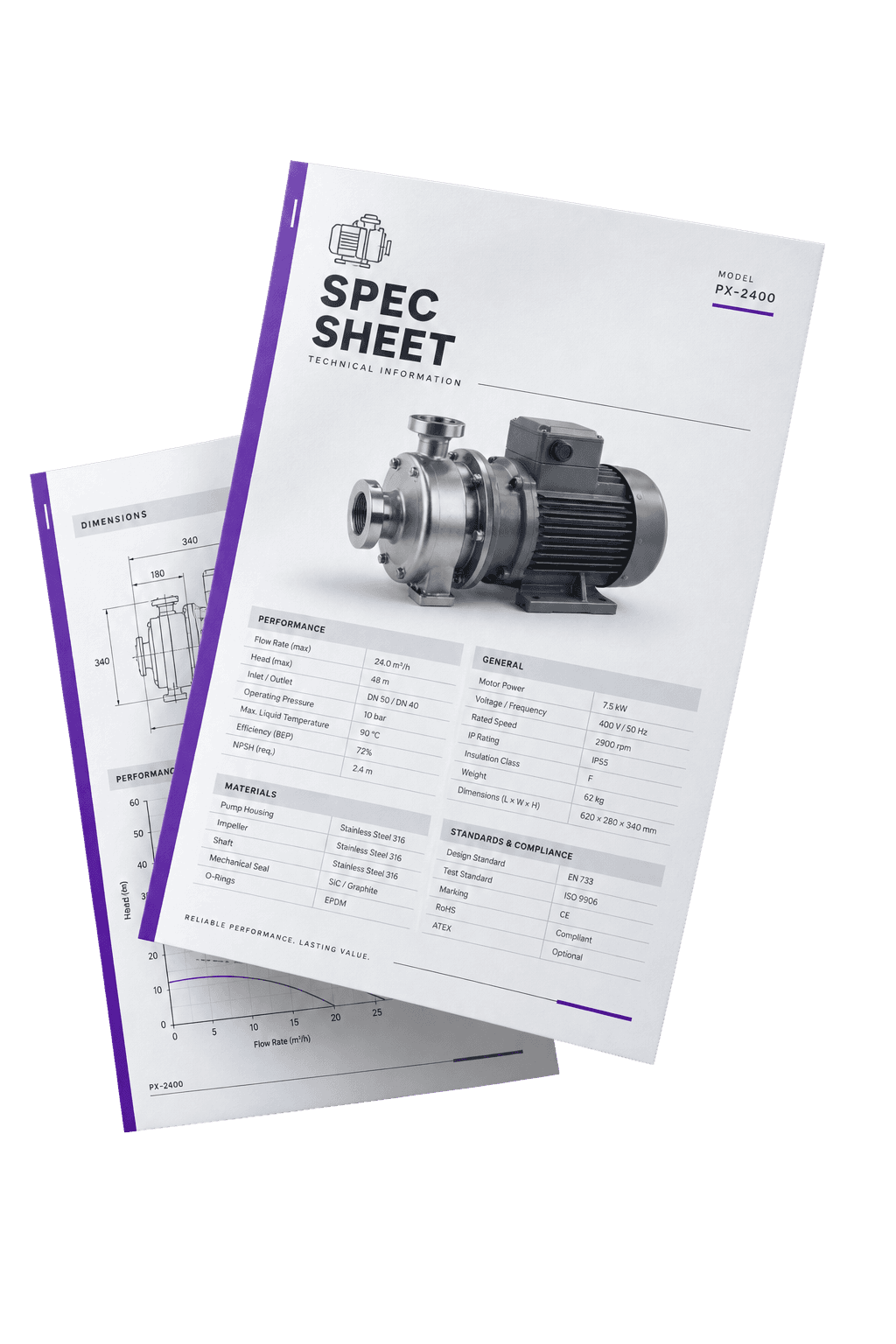
What is the difference between a spec sheet and a sell sheet?
A spec sheet states facts and a sell sheet makes an argument. The spec sheet is for an engineer or a buyer checking fit, and answers whether the product works in their application. The sell sheet is for a distributor or a retail buyer, and answers why they should stock it. Most products need both, and the sell sheet should link to the spec sheet rather than trying to contain it.
- Spec sheet reader
- An engineer or specifier
- Sell sheet reader
- A buyer or a rep
- Who signs each off
- Engineering, then sales
- Length
- One page each
What is a line card, and how is it different from a line sheet?
A line card is the list of manufacturers a distributor is authorised to represent, with the product families it carries from each, and it answers one question: can you get me this brand. A line sheet is the opposite direction, a brand showing a buyer what it sells and at what price. Different author, different reader, and they get filed together constantly.
- Line card author
- A distributor
- Line sheet author
- A brand
- Prices on a line card
- None
- The field most often missing
- An issue date
The values are yours, the layout is the part that stalls
Paste your website address and the sheet comes out in your firm's real colours, fonts and logo, as a PDF you can send or publish. Blendin will not invent a figure to fill a field.
Free for 14 days on the full Starter plan, card required, no charge today, then $59 a month, cancel anytime.
The two documents, side by side
They are often confused because they are the same size and often sit in the same folder. Everything else about them differs, including who is allowed to approve them.
| Attribute | Spec sheet | Sell sheet |
|---|---|---|
| Who reads it | An engineer, a specifier, a buyer checking fit, an installer | A distributor, a retail buyer, a rep, an end customer choosing |
| The question it answers | Will this work in my application | Why should I stock or buy this one |
| What it is made of | Measured values, tolerances, standards, part numbers | A benefit, a proof, a price position, a call to action |
| Tone | Flat. No adjectives. Nothing is described as innovative | Persuasive, but grounded in a fact the spec sheet can back |
| Length | One page, occasionally two when the table is genuinely long | One page. A second page is a brochure and reads as one |
| Images | A dimensioned drawing or a plain product photograph | A hero photograph of the product in use, plus the packaging |
| Who signs it off | Engineering or quality, because a wrong value is a returned order | Sales or marketing, because it is a claim rather than a value |
| How often it changes | When the product changes, and it carries a revision and a date | When the pitch, the price band or the season changes |
| Where it ends up | A submittal package, a quote, a website download, a portal | An email, a trade show table, a distributor pack, a feed post |
A drawing, a value table, and the revision strip most sheets in circulation do not carry
A full parameter list belongs in a manual. The sheet carries identity, the two or three ratings buyers compare on, the operating range, compliance and the ordering detail, and every number on it states its unit.
What goes on a spec sheet, group by group
Five groups, and the last one is what almost every sheet in circulation is missing.
Identity
- Product name and model
- Manufacturer part number
- SKU or catalogue number
- Series or family it belongs to
- A one line description of what it is
Physical
- Dimensions, with the unit stated
- Weight, packed and unpacked
- Materials and finish
- Colour or variant options
- Mounting, connection or fitting type
Performance
- The two or three ratings buyers actually compare on
- Operating range: temperature, pressure, load, voltage
- Tolerances, and whether they are typical or guaranteed
- Duty cycle, service life or expected consumable interval
- Anything measured under a named test method
Compliance
- Standards met, each with its number
- Certifications and listings, with the certifying body
- Country of origin and tariff code where trade needs it
- Warranty term and what it covers
- Safety or handling notes that belong on the sheet
Ordering and control
- Minimum order quantity and pack size
- Lead time, stated honestly or marked as quoted
- Related and replacement part numbers
- Revision number and issue date
- Who to contact, and where the current version lives
The revision strip is the field that earns the trust
A revision number, an issue date and what it supersedes. Most sheets in circulation are older than the product they describe, and a reader who has been caught by that once treats every undated sheet the same way afterwards.
[Product name]
Model [xxx] · Part no. [xxx]
| Dimensions | [ ]mm |
|---|---|
| Weight, unpacked | [ ]kg |
| Operating range | [ ]°C |
| Tolerance | [ guaranteed ] |
Somebody holds your sheet next to the real part
A spec sheet is read standing at a workbench as often as it is read on a screen. The numbers on it get checked against the actual product before anyone calls you, which is why a wrong value is a returned order rather than a typo.
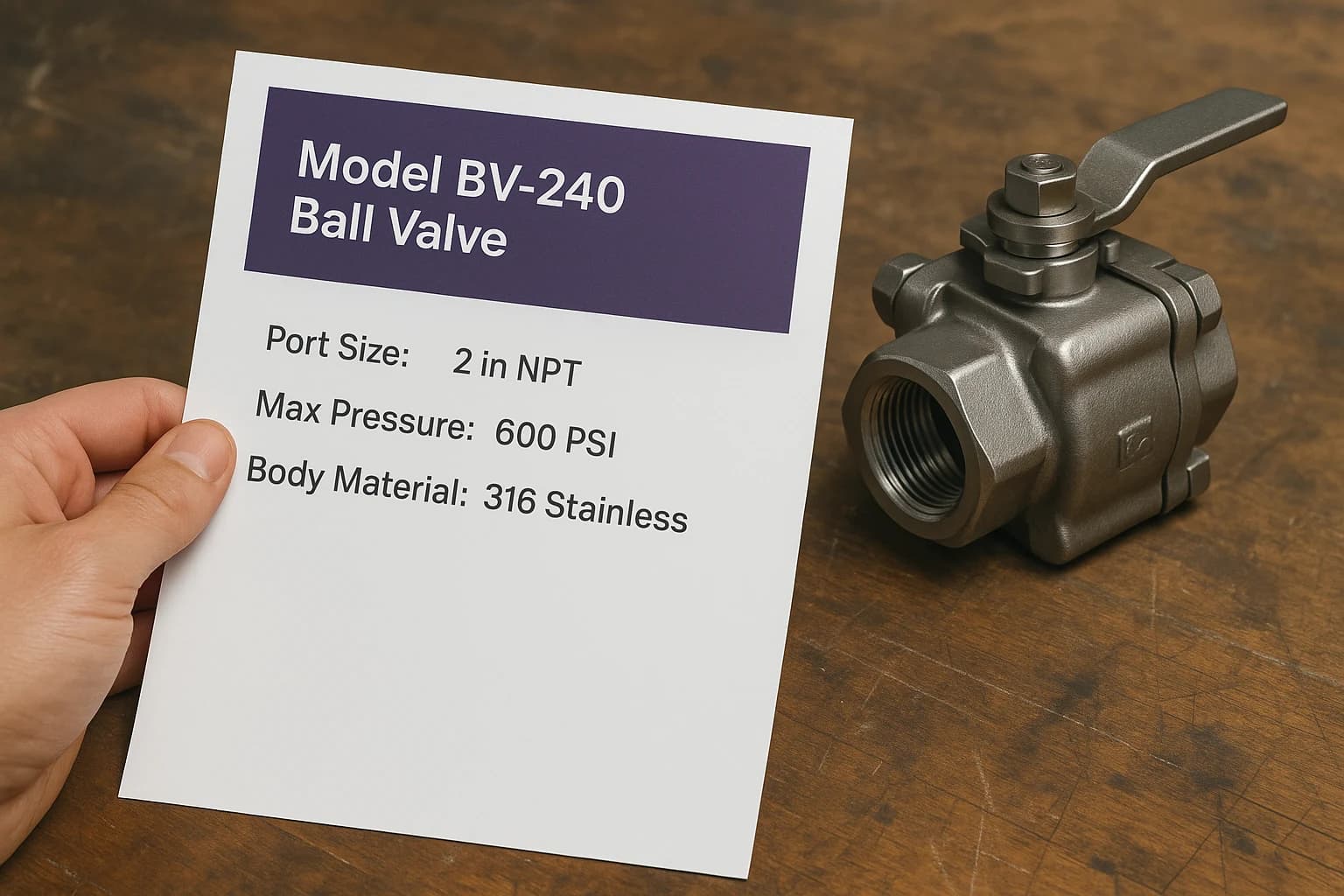
The same size page, arranged for the opposite reader
Three benefits and a proof strip replace the value table, and the layout stays a one page test: a second page reads as a brochure. It works only when every claim behind it is anchored to something the spec sheet can prove.
What goes on a sell sheet
Six blocks, in this order down the page. The rule that governs all of them: every claim is anchored to something the spec sheet can prove, which is why the sell sheet is written second.
One headline that is a claim, not a name
The top of the page says what the product does for the person reading, in their words. Putting the model number where the headline should be is the most common way a sell sheet wastes its best real estate.
A photograph of the product doing its job
In use, at the scale it is really used, ideally in the environment the reader recognises. A cut out on white belongs on the spec sheet. If retail is the audience, show the packaging too, because that is what will sit on their shelf.
Three benefits, each anchored to a fact
Three, not six. Each one names something the spec sheet can prove: a measured figure, a certification, a warranty term, a lead time you hold. A benefit with nothing behind it is the line a buyer stops reading at.
The proof strip
Whatever you genuinely have. A certification mark, a standard met, a named customer who agreed to be named, a test result, years in production. One real proof beats a row of logos you cannot stand behind.
The commercial block
Case pack, minimum order, price position or margin where it is a trade sheet, lead time and availability. A distributor deciding what to stock needs this on the page rather than in a follow up email.
One next step and one contact
Ask for the specific thing you want: a sample, a stocking order, a meeting at the show. Name a person with a direct line. A sell sheet with no ask is a brochure.
[What it does for the reader, not the model number]
[Who it is for, and the situation it is for]
- [Benefit] because [a fact from the spec sheet]
- [Benefit] because [a fact from the spec sheet]
- [Benefit] because [a fact from the spec sheet]
Five ways either sheet ends up unused
The two documents get merged into one
A page carrying both a marketing headline and forty rows of technical values serves neither reader. The engineer distrusts the adjectives and the buyer cannot find the argument. Make two, and let them link to each other.
No revision number and no date
This is the single field that separates a sheet somebody trusts from one they call to check. A spec sheet with no revision could be from any year, and a specifier who has been caught out once will not use it again.
Units missing or mixed
A number with no unit is not a specification. Pick a primary unit system, state it, and put the conversion in brackets rather than switching between them down the page.
Every value marked typical
If nothing is guaranteed, nothing can be designed in. Mark what is guaranteed as guaranteed and what is typical as typical. Buyers read that distinction closely and it is the fastest credibility on the page.
The sheet lives in one person's folder
Put the current version somewhere a customer can reach without asking, and make sure the version they download is the one engineering last approved. Most sheets in circulation are older than the product.
The third document: a line sheet
A line sheet is the wholesale product and price sheet a brand sends a buyer. It covers a whole range rather than one product, and it carries the commercial terms, so a buyer can decide what to order and place the order without a follow up email. It is what a retail buyer, a boutique owner or a rep at a trade show asks for when they say send me your line sheet.
It is not a line card, which is the opposite direction entirely and has its own section below.
[Brand]
[Season or collection]
Order by [date] · Cancel [date] · Ships [window]
| Style | Wholesale | Retail | Case pack | Minimum |
|---|---|---|---|---|
| HR-1041[Style name]3 colourways · [size run] | [ ] | [ ] | [ ] | [ ] |
| HR-1042[Style name]2 colourways · [size run] | [ ] | [ ] | [ ] | [ ] |
| HR-1058[Style name]5 colourways · [size run] | [ ] | [ ] | [ ] | [ ] |
What goes at the top of the sheet, once
- Brand name and logo, and the season or collection the sheet covers
- Order date and cancel date, so a buyer knows the window
- Ship window or delivery dates
- Payment terms, shipping terms and who pays freight
- Order minimum for the whole order, separate from any per style minimum
- How to order, and one named person who answers
What goes on every style row
- Product image, and a second view where the back or the detail sells it
- Style name and style number
- Colourways, and which are available in this window
- Size run or variant list
- Material, composition or contents
- Wholesale price
- Suggested retail price
- Case pack or pre pack, and the per style minimum
The one rule a line sheet lives or dies on
Put the wholesale price and the suggested retail price next to each other, on the same row, in the buyer's currency. A buyer is working out their margin, and a sheet that makes them do arithmetic in another tab is a sheet that gets set aside for the one that did not. The same logic governs case pack, minimum and ship window: every field you leave off becomes an email, and every email is a week.
And where a sales brochure fits
A brochure is the multi page company or range document you hand over at a show or leave behind after a visit. It is the only one of these four that is allowed to be about you rather than about a product. Before you commit to one, it is worth asking whether what you actually need is three sell sheets and a cover page, because that version is cheaper to keep current, and you can send one page of it to somebody who only asked about one product.
A line sheet and a line card point in opposite directions
They share a word and nothing else. One is a brand showing a buyer what it sells and at what price. The other is a distributor listing the manufacturers it is authorised to represent, and it carries no prices at all.
The fourth document: a line card
A line card is the one page a distributor uses to show which manufacturers it is authorised to represent and what it carries from each. It answers a single question for a buyer, which is whether you can get them a particular brand, and it is the thing handed over at a counter, at a trade show, or in the first five minutes of a first meeting.
It is a capability document rather than a quotation, so it carries no prices, and it carries the territory you are authorised in, because distribution rights are geographic. It lives on this page rather than one of its own for a plain reason: the same distributor who asks a manufacturer for a spec sheet on Monday is rebuilding their own line card on Friday.
What goes on one
- Your own name, logo and one line saying what kind of distributor you are
- The territory you are authorised to sell in, because a buyer outside it is wasting both of you
- Each manufacturer you represent, by its real name, grouped so the list can be scanned
- What you carry from each one: the product families, not every part number
- Whether you are an authorised distributor, a stocking distributor or a rep, per line
- The markets you serve, in the words those markets use
- Value added services: kitting, cutting, fabrication, calibration, next day, consignment
- Certifications and approvals that let you sell into regulated work
- One named contact per region or per line, with a direct number
- An issue date, because lines get added and dropped and an old card sends business elsewhere
Every manufacturer at the same size
A line card is a hierarchy pretending to be a list. The lines you actually want to be called about go first and bigger. A wall of forty identical logos tells a buyer nothing about what you are good at.
Logos with no product families beside them
A buyer knows the brand and does not know which part of it you stock. Two or three words per line, naming the families, is the difference between a card that generates a call and one that generates a search.
No issue date, and a line you dropped last year
A line card is the document most likely to be out of date in the field, because it is printed, handed over and kept. Date it, and reissue when a line changes rather than when somebody notices.
No territory stated
Distribution rights are geographic. A card with no territory on it gets forwarded out of your area, and the call you get is one you have to turn down.
The one thing a line card is competing against
A search. If a buyer cannot tell from your card whether you stock the family they need, they will type the manufacturer name and a city into a search box and find somebody who said so.
All four templates, in plain text
Field labels and order, nothing else, so they will not fight whatever you write in. Fill the spec sheet first, then write the sell sheet from it.
| Document | Who reads it | What they are deciding |
|---|---|---|
| Spec sheet | An engineer or a specifier | Whether it works in their application |
| Sell sheet | A buyer or a rep | Whether to stock or buy this one |
| Line sheet | A retail buyer, with an order to place | What to order from a range, and at what margin |
| Line card | Anybody sourcing a brand | Whether you can get it for them |
Spec sheet template
PRODUCT SPECIFICATION SHEET

[Product name]  |  Model [xxx]  |  Part no. [xxx]
[One line description of what it is and what it is for]

IDENTITY
Model / part number: [ ]
SKU or catalogue number: [ ]
Series or family: [ ]

PHYSICAL
Dimensions (state the unit): [ ]
Weight, unpacked / packed: [ ]
Materials and finish: [ ]
Options or variants: [ ]
Mounting or connection: [ ]

PERFORMANCE
[Primary rating buyers compare on]: [value, guaranteed or typical]
[Second rating]: [value, guaranteed or typical]
Operating range: [temperature / pressure / load / voltage]
Tolerance: [value, and the test method]
Service life or duty cycle: [ ]

COMPLIANCE
Standards met: [number, and the body]
Certifications and listings: [ ]
Country of origin: [ ]
Warranty: [term, and what it covers]

ORDERING
Minimum order quantity / pack size: [ ]
Lead time: [ ]
Related and replacement parts: [ ]

DOCUMENT CONTROL
Revision: [ ]    Issue date: [ ]    Supersedes: [ ]
Current version: [where a customer can download it]
Contact: [name, direct line, named inbox]
Sell sheet template
SELL SHEET

HEADLINE
[What it does for the reader. Not the model number.]

SUBHEAD
[One sentence naming who it is for and the situation it is for.]

[ HERO IMAGE: the product in use, at real scale ]
[ SECONDARY IMAGE: the packaging, if the buyer is retail or trade ]

WHY IT SELLS
1. [Benefit] because [a fact from the spec sheet]
2. [Benefit] because [a fact from the spec sheet]
3. [Benefit] because [a fact from the spec sheet]

PROOF
[Certification, standard met, test result, named customer, years in production]

THE COMMERCIAL DETAIL
Case pack / minimum order: [ ]
Lead time and availability: [ ]
Price position or trade margin: [ ]
Full specification: [link to the spec sheet]

THE ASK
[Sample, stocking order, meeting at the show, trial]
[Name, title, direct line, named inbox]
Line sheet template
LINE SHEET

[Brand name]  |  [Season or collection]
Order by: [date]      Cancel: [date]      Ships: [window]
Terms: [payment terms]  |  [shipping terms]  |  Order minimum: [ ]

STYLE [number] . [Style name]
[ IMAGE ]  [ SECOND VIEW ]
Colourways: [ ]
Sizes / variants: [ ]
Material or contents: [ ]
Wholesale: [ ]        Suggested retail: [ ]
Case pack: [ ]        Minimum per style: [ ]

STYLE [number] . [Style name]
[repeat the block for each style, in the order you want them bought]

HOW TO ORDER
[Named person, direct line, named inbox]
[Ordering link or portal, and the terms a first order is subject to]
Line card template
LINE CARD

[Distributor name]  |  [what kind of distributor you are]
Territory: [states, regions or countries you are authorised in]
Issued: [date]

LINES WE REPRESENT
[Manufacturer]  .  [product families you stock]  .  [authorised / stocking / rep]
[Manufacturer]  .  [product families you stock]  .  [authorised / stocking / rep]
[Manufacturer]  .  [product families you stock]  .  [authorised / stocking / rep]

MARKETS WE SERVE
[Industry]  |  [Industry]  |  [Industry]

WHAT WE ADD
[Kitting, cutting, fabrication, calibration, next day, consignment, stocking programmes]

CERTIFICATIONS AND APPROVALS
[Only what you hold, with the body that issued it]

CONTACT
[Name], [region or line]  |  [direct line]  |  [named inbox]
How to make one, in order
- 1
Decide which document you are actually making
Write down the one question your reader has. If it is will this work in my application, you are making a spec sheet. If it is why should I stock or buy this, you are making a sell sheet. If it is both, you are making two documents, and trying to make one is the mistake that produces a page nobody uses.
- 2
Collect the values from the source, not from the old sheet
Take dimensions, ratings, tolerances and certifications from engineering or from the current test report. Copying the previous sheet is how a superseded value survives three product revisions. State the unit on every number and mark each value as guaranteed or typical.
- 3
Cut the list to what a buyer compares on
A full parameter list belongs in a manual. A spec sheet carries identity, the two or three ratings buyers actually compare, the operating range, compliance and the ordering detail. Everything else can live behind a link.
- 4
Write the sell sheet from the spec sheet, never the other way round
Take three benefits and, for each, name the figure or certification on the spec sheet that proves it. A benefit with nothing behind it either gets cut or gets a fact found for it. Then add the commercial block and one specific ask.
- 5
Stamp a revision and put it where customers can reach it
Revision number, issue date, and what it supersedes. Publish it in your own brand as a PDF, and put the current version somewhere a customer can download without asking. In Blendin, paste your website address so the sheet comes out in your real colours and type, then download it or publish it as a LinkedIn document.
Twenty questions about these four documents, answered in one line
Each row is a separate question, with its own link. If one of them is the reason you are here, take the answer and go.
| The question | The short answer |
|---|---|
| What is a spec sheet? | A one page document stating the measured facts about a product: dimensions, materials, ratings, standards and the part numbers used to order it.It carries no persuasion, and it carries a revision number and a date. |
| What is a sell sheet? | A one page document arguing why somebody should stock or buy the product, with every claim anchored to a fact the spec sheet can prove. |
| What is the difference between a spec sheet and a sell sheet? | A spec sheet states facts for somebody checking fit. A sell sheet makes an argument for somebody deciding whether to buy.Engineering signs the first, sales signs the second. |
| Is a data sheet the same as a spec sheet? | In everyday use yes. Data sheet, product data sheet, technical data sheet and tech sheet all name the same document.A safety data sheet is a different, regulated document and never a substitute. |
| What is a cut sheet? | The same document again, in construction, lighting and plumbing, where it goes into a submittal package. |
| How long should a spec sheet be? | One page, and two only when the table is genuinely that long. |
| What is a revision number for? | It tells a reader which version they are holding, and it is the single field that separates a sheet somebody designs against from one they phone to check. |
| Should a spec sheet include a price? | Usually not. Prices change on a different clock from specifications, and a dated price makes the whole sheet look stale. |
| What does typical mean on a spec sheet? | That the value is representative rather than promised. Mark what is guaranteed as guaranteed, or nothing can be designed in. |
| What is a line sheet? | The wholesale product and price sheet a brand sends a buyer: one row per style, with the commercial terms at the top. |
| What goes on a line sheet? | Per style: an image, style name and number, colourways, sizes, materials, wholesale price, suggested retail, case pack and minimum. |
| Why put wholesale and retail price on the same row? | Because the buyer is working out their margin, and a sheet that makes them do it in another tab loses to one that does not. |
| What is a line card? | The list of manufacturers a distributor is authorised to represent, with the product families it carries from each.It answers one question: can you get me this brand. |
| What is the difference between a line card and a line sheet? | A line sheet is a brand showing a buyer what it sells and at what price. A line card is a distributor listing whose products it can supply.Different author, different reader, different job, and they get filed together constantly. |
| What goes on a line card? | Your name and territory, each manufacturer with the families you stock, your markets, your value added services, certifications, a named contact and an issue date. |
| How many lines should be on a line card? | As many as you genuinely represent, ordered so the ones you want to be called about are first and largest.A wall of forty identical logos tells a buyer nothing about what you are good at. |
| Does a line card need prices? | No. It is a capability document, not a quotation, and prices on it date the whole card. |
| What is a sales brochure, and do I need one? | A multi page company or range document handed over at a show. Three sell sheets and a cover page is usually cheaper to keep current. |
| Which document does a distributor want from me? | Both, and lead with the sell sheet. They are making a commercial decision, then their technical people want the spec sheet. |
| Do I need a designer to make these? | No. They fail on a missing unit, a missing revision or six benefits where three would do, none of which a designer fixes. |
Where Blendin fits, and where it does not
The values are yours and the judgement is yours. What Blendin removes is the layout step, and the reason the sheet you eventually make looks like a template rather than like your company.
What it does
- Reads your website and builds the brand from the real colours, fonts and logo already on your own pages.
- Lays the sheet out as a PDF you can download and send, or publish as a native LinkedIn document post that is swiped in the feed.
- Lets you place text, shapes, images and your logo by hand afterwards, which is free on every plan.
- Keeps one brand across the sheet and everything else you publish, so a distributor sees the same company in both places.
What it will not do
The fabrication ban matters here because somebody orders from this document, and a wrong value is a returned order rather than a bad sentence.
- It will not invent a dimension, a rating, a tolerance, a certification or a lead time. You supply every value.
- It is not the source of truth for a catalogue. Keep the values in your own product data system and treat this as the presentation layer.
- It does not replace an engineering review. Somebody who knows the product still reads the page before it goes out.
- It does not manage revisions or tell you which sheet in circulation is current. That is a process problem and it is yours.
- It will not price anything, hold a rate card, or take an order.
How it is charged, plainly: a document is not sold separately and there is no extra purchase for it. It draws on the same monthly allowance as everything else you make, counted by the pages it generates, on plans at 59, 139 and 249 dollars a month.
Questions
What is a spec sheet?
A spec sheet, short for specification sheet, is a one page document that states the measured facts about a product: what it is, its dimensions and materials, the performance figures buyers compare on, the standards and certifications it meets, and the part numbers used to order it. Its job is to let somebody decide whether the product fits their application without calling you. It carries no persuasion, and it carries a revision number and a date so a reader knows which version they are holding.
What is the difference between a spec sheet and a sell sheet?
A spec sheet states facts and a sell sheet makes an argument. The spec sheet is written for an engineer, a specifier or a buyer checking fit, and it answers the question will this work in my application. The sell sheet is written for a distributor, a retail buyer or a rep, and it answers the question why should I stock or buy this one. They carry different content, different tone, and usually different sign off: engineering owns the first because a wrong value is a returned order, and sales owns the second because it is a claim rather than a value. Most products need both, and the sell sheet should link to the spec sheet rather than trying to contain it.
Is a data sheet the same as a spec sheet?
In everyday use, yes. Data sheet, product data sheet, technical data sheet, tech sheet and specification sheet all describe the same document, and which term you hear depends on the industry. Cut sheet is the same document again in construction, lighting and plumbing, where it goes into a submittal package. The one real distinction worth keeping is that a safety data sheet is a different, regulated document with a mandated format, and it is never a substitute for a product spec sheet.
How long should a spec sheet be?
One page whenever the values fit on one, and two only when the table is genuinely that long. What matters more than the count is that the page a reader downloads is the current version, which is why a revision number and an issue date belong on every spec sheet and are the field most often missing.
What should a sell sheet include?
Six things. A headline that is a claim rather than a product name, a photograph of the product doing its job, three benefits each anchored to a fact the spec sheet can prove, one honest proof point, the commercial detail a buyer needs to act (case pack, minimum order, lead time, price position), and one specific ask with a named contact. Three benefits, not six: a sell sheet loses more often to clutter than to weak content.
What is a line sheet, and how is it different from a sell sheet?
A line sheet is the wholesale product and price sheet a brand sends a buyer. It covers a whole range rather than one product, one row per style, and it carries the commercial terms, so a buyer can choose what to order and order it without a follow up email. A sell sheet argues for one product; a line sheet lists many and prices them. The rule that matters most on a line sheet is to put the wholesale price and the suggested retail price on the same row, because the buyer is working out their margin and a sheet that makes them do it elsewhere loses to one that does not.
Is a line sheet the same as a line card?
No, and they get filed together constantly. A line sheet is a brand showing a buyer what it sells and at what price. A line card is a distributor listing the manufacturers it represents, so a customer can see which brands it can supply. Different author, different reader, different job.
What is a line card?
A line card is the one page document a distributor uses to show which manufacturers it is authorised to represent and what it carries from each of them. It answers a single question for a buyer, which is whether you can get them a particular brand, and it is usually the first thing handed over at a counter, a trade show or a first meeting. It is a capability document rather than a quotation, so it carries no prices, and it carries the territory you are authorised in, because distribution rights are geographic and a card forwarded outside your area produces a call you have to turn down.
What goes on a line card?
Your own name, logo and one line saying what kind of distributor you are. The territory you are authorised in. Each manufacturer by its real name, grouped so the list can be scanned, with two or three words beside each naming the product families you actually stock rather than every part number. Whether you are an authorised distributor, a stocking distributor or a rep, per line. The markets you serve. Your value added services, meaning kitting, cutting, fabrication, calibration, next day, consignment. Certifications that let you sell into regulated work. One named contact with a direct number. And an issue date, because lines get added and dropped and an old card sends business to somebody else.
Why is my line card not producing calls?
Usually one of four things, and none of them is design. Every manufacturer is set at the same size, so the card is a hierarchy pretending to be a list and a buyer cannot tell what you are good at. The logos carry no product families beside them, so a buyer who knows the brand still does not know which part of it you stock. There is no issue date and at least one line is out of date, which is the most common failure because a line card is printed, handed over and kept. Or there is no territory on it, so it gets forwarded out of your area.
Which one do I need if a distributor asks for a sheet on my product?
Send both, and lead with the sell sheet. A distributor is deciding whether to carry the line, which is a commercial decision, so the sell sheet is the document that answers them. Their technical people, their installers and their own customers will then want the spec sheet, so it should be attached or one click away rather than promised in a follow up.
Do I need a designer to make one?
No, and the design mistakes that actually cost you are not the ones a designer is hired to fix. A spec sheet fails on a missing unit, a missing revision or a value nobody can source, and a sell sheet fails on six benefits where three would do. Get those right in plain text first. What design buys you after that is real and worth having, which is that a sheet in your own colours, type and logo reads as a company rather than as a template.
How does Blendin make one?
You paste your website address and it reads the real colours, fonts and logo off your own pages, then lays the sheet out in them as a PDF you can download and send or publish as a LinkedIn document post. You supply every figure. It will not invent a dimension, a rating, a certification or a lead time, which is the only safe way to generate a document somebody is going to order from. For a catalogue of hundreds of parts, keep the values in your own product data system and use Blendin for the presentation layer rather than as the source of truth.
Paste the company URL and the brand comes back
Blendin reads the real colours, fonts, logo and tone off your own site and builds a brand kit from them. It never invents a brand colour that is not there, which is the same rule this whole page runs on: real signal or nothing.
Related documents
Selling to government or enterprise
The one page they ask for first. Capability statement.
Winning the work, and proving it
The proposal, the job bid and the rate sheet on the service proposal page, and the case study you write after.
The wider case
What to publish as a manufacturer or distributor, on industrial marketing, every template on the hub, and the plans.
Make it in your own brand
Paste your website address and the sheet comes out in your real colours, fonts and logo. Free for 14 days on the full Starter plan, card required, no charge today, then 59 dollars a month, cancel anytime.
Start the free trial