LinkedIn is one of the most-cited sources in AI search. Here's how to get quoted.
A large study of the LinkedIn URLs AI engines cite shows what they quote: long-form, educational, original posts. The publish-this-way checklist to get cited.
Your next reader might never see your profile. They will ask an AI assistant a question, read the answer it composes, and click the two or three sources it decided to trust. That shift is quietly rewriting what it means to be a recognized voice in your niche. The question is no longer only "who follows me," it is "who does the machine quote when someone asks about my topic." And on that scoreboard, LinkedIn is doing far better than most people realize.
LinkedIn is one of the most-cited sources in AI search
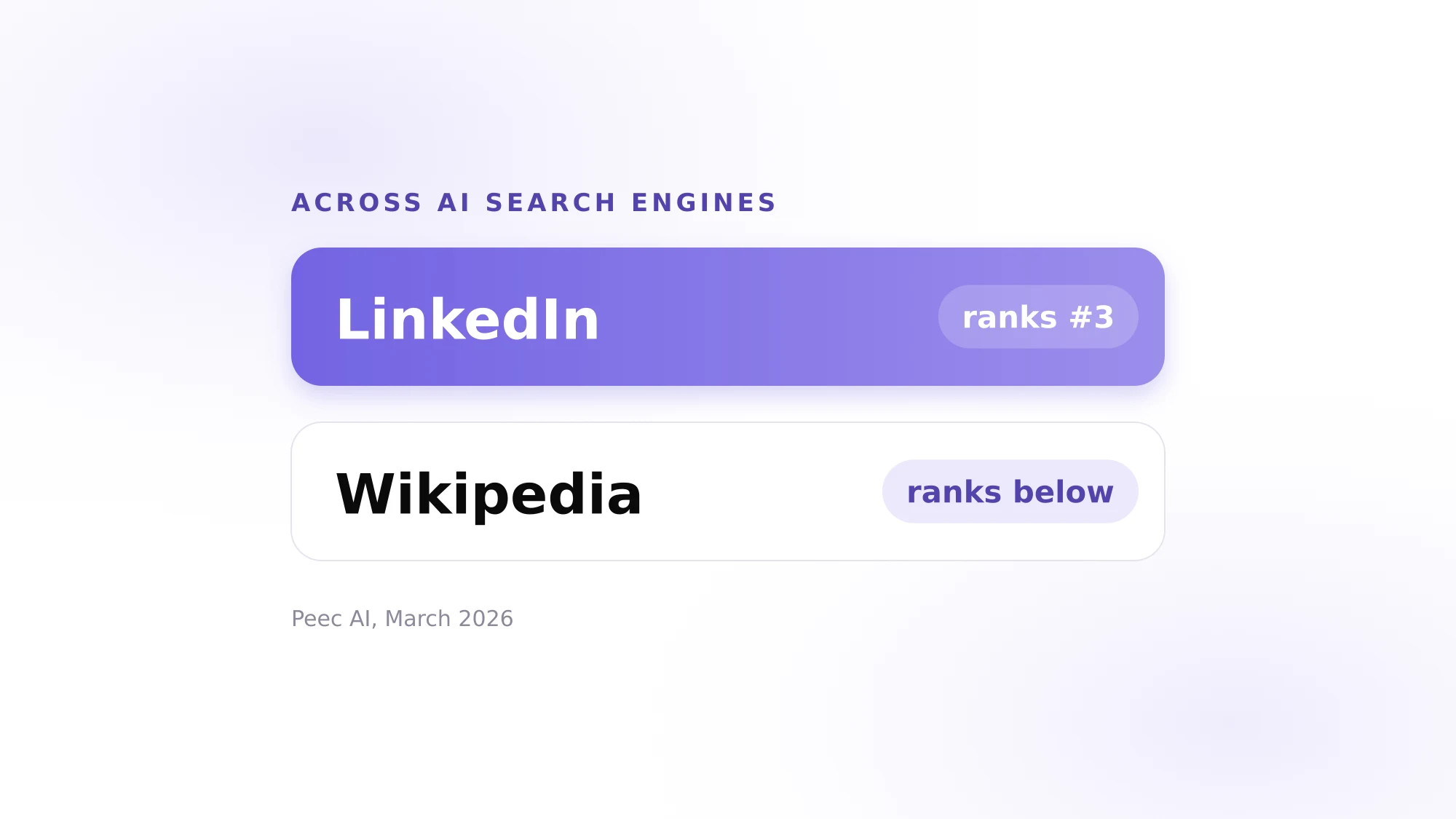
Across AI search engines in 2026, LinkedIn ranks #3, above Wikipedia, per Peec AI's March 2026 analysis. That is a third-party result, and it is worth sitting with. Of every website on the open internet, an AI assistant reaching for a source lands on LinkedIn more often than almost anywhere else.
Rankings like this move a little depending on which engines and which questions a study measures, so you will see LinkedIn placed higher in some analyses and lower in others. The important part is not the exact slot, it is the shape: across the studies that look at this, LinkedIn sits at or very near the top of the sources AI engines trust. For anyone building thought leadership, that is a rare piece of good news. The platform you already post on is one the machines already read.
Semrush went a level deeper in its 2026 LinkedIn AI Visibility Study, analyzing a large set of LinkedIn URLs that AI engines actually cited across several engines. Its headline matches the ranking above: LinkedIn is among the most-cited domains in AI search. How often a citation actually happens depends on the engine. LinkedIn showed up in a meaningful minority of AI responses overall, noticeably more on some engines than on others. That is not a rounding error. That is a distribution channel, and it is uneven by engine.
One quick myth to retire before it spreads. You may have seen a version of this study framed as "LinkedIn is cited in nearly every AI answer." That is a misread. The big figure behind it describes how many cited LinkedIn posts were original rather than reshares. It is not the share of answers that cite LinkedIn. The honest picture is a meaningful minority of responses, varying by engine, all per Semrush.
What AI engines actually quote from LinkedIn
Here is where the study turns from interesting into useful, because it does not stop at "LinkedIn gets cited." It looks at exactly which LinkedIn content the engines reach for, and the pattern is specific enough to publish against.
The single biggest finding is that long-form wins. According to Semrush, LinkedIn Articles, the long-form format, made up the largest share of all cited LinkedIn content across the engines it tested. Ordinary feed posts, the everyday updates that fill your timeline, accounted for a much smaller share. Read that again, because it inverts how most creators spend their time. The format almost nobody publishes anymore, the article, is the one the machines quote most. The format everyone fights over, the feed post, is cited far less often.
Length matters too, in both directions. Semrush found a clear sweet spot: cited articles were substantial without being padded, and cited feed posts clustered at a mid-length. The takeaway is not "write longer" as a blanket rule. It is that an engine needs enough substance to extract a claim from, but not a wall of filler it has to wade through. Enough to say something, short enough to say it cleanly.
Then there is the content itself. Semrush reports that most cited posts were educational, meaning they shared knowledge or practical advice rather than announcements, hot takes, or personal updates. And the great majority of cited posts were original, with reshares making up only a small minority. The engines are not quoting your repost of someone else's chart. They are quoting the person who explained the thing first, in their own words. Originality is the whole ballgame.
Notice what all of this adds up to. AI engines are, in effect, rewarding exactly the behavior that builds real authority anyway: teach something specific, in your own voice, at enough length to be useful, and be the source rather than the amplifier. The machine-friendly move and the human-authority move turn out to be the same move.
The publish-this-way checklist
Translate the study into a routine and it becomes a short list you can run before you hit publish. None of this is a hack. It is a description of what already gets cited, per Semrush, turned into instructions.
- Write more long-form. Articles were the largest share of cited LinkedIn content. If you have been pouring everything into 200-word feed posts, move some of that energy into a real article on the thing you know best. It is the most under-published, most-quoted format on the platform.
- Aim for the length sweet spot. Substantial for an article, mid-length for a feed post, the bands Semrush found among cited content. Long enough to make a claim, tight enough that the claim is easy to lift.
- Teach, do not announce. Most cited posts were educational. Lead with a lesson, a method, a number, a "here is how," not a "thrilled to share." If a reader could learn one concrete thing from your post, an engine can extract one concrete claim from it.
- Publish original, not reshares. The great majority of cited posts were original. Your repost of a stat with "so true" adds nothing an engine can quote. Say the thing yourself.
- Be specific and sourced. The posts that get quoted make checkable claims: a named number, a real example, a dated result. Abstraction is unquotable. A specific is a citation waiting to happen.
- Sound like a person. Generic AI-flavored writing gets low engagement and low trust, and it is the least quotable prose there is. The posts engines cite read like a knowledgeable human explaining something, which is also the only writing that earns a human reader.
- Post consistently. This one has its own section below, because the cadence finding is stronger than most people would guess.
If drafting original long-form on a schedule sounds like more than you can sustain solo, that is the exact gap our writing engine is built to close. It drafts an on-brand article or post from one idea, in your voice, so the substance is yours and the blank page is not the thing standing between you and being quotable. You still approve and schedule every post. You can start a draft with the free AI LinkedIn Post Generator and see the shape of it in a few seconds.
The cadence and reputation signals
Being quotable is not only about a single perfect post. Semrush also looked at who the cited authors were, and two signals stood out. Most cited authors were frequent posters, publishing several times in a four-week window. And many of them already had a visible audience. The engines, in other words, lean toward people who show up regularly and have built a following.
Do not read the follower count as a wall you cannot climb. Read it as the output of consistency, not the entry fee for it. Authors build an audience by posting useful things repeatedly, which is the same habit that produces the body of quotable work in the first place. The cadence is the cause. The audience is the effect. Chase the cadence and the rest follows.
There is a reassuring detail here too. Per Semrush, most cited posts had only moderate engagement, not the viral monsters that dominate the feed. You do not need a post to explode to be quoted. You need it to be clear, specific, and findable. A steady stream of solid, teach-something posts beats one lucky viral hit for this kind of visibility. If becoming a recognized voice is the goal, this is the deeper playbook we laid out in our guide to becoming a LinkedIn Top Voice in 2026.
Creators or Company Pages: it depends on the engine
One more finding is worth knowing if you post from both a personal profile and a brand. Semrush found that the engines split on whether they prefer individuals or companies. Some engines cited individual creators most often. At least one went the other way, citing Company Pages most often.
For a founder, a consultant, or whoever runs marketing at a services company, the practical read is simple. Your personal profile is your strongest asset for the engines that favor individuals, so it deserves the bulk of your best original writing. But a Company Page is not dead weight. It is your line into the engines that favor pages, and it is the one that carries the company name a buyer is checking out. If you run both a personal brand and a business, publishing thoughtfully from each covers more of the map than picking one. On Blendin, LinkedIn personal profiles and Company Pages both publish from Starter (which every new account tries free for 14 days), so running both from one workspace is the same amount of effort as running one.
Write for the reader, and the machine follows
It would be easy to read all of this as a new game to min-max: stuff keywords, pad word counts, game the format. Do not. The engines are trained on human judgment, and the thing they reward is the thing a careful human reader rewards too, a clear, specific, original explanation from someone who actually knows the topic. Every signal in the Semrush study points the same direction: educational, original, specific, human.
That is why the anti-AI writing part is not a side note. Generic machine-sounding posts do poorly with humans and are the least quotable writing there is, because they say nothing specific enough to lift. If you want the full breakdown of what makes writing read as generated, and how to strip it out, we wrote it up in the guide to the AI writing tells that give a post away. You can also paste any draft into our free AI Writing Checker and get a plain human-ness score before you publish. Sounding like yourself is not just good taste anymore. In 2026 it is a visibility input, for the feed and for the machines quoting it.
This is about what gets an individual post cited. A related question is what gets a whole PRODUCT cited when someone asks an assistant which tool to use. We ran a separate panel on exactly that, and the pattern in what AI assistants cite for content-tool questions turns out to reward the same thing this study does: specific, original, and honestly sourced.
Frequently asked questions
Is LinkedIn really one of the most-cited sources in AI search?
Yes. Across AI search engines in 2026, LinkedIn ranks #3, above Wikipedia (Peec AI, March 2026). Semrush's 2026 LinkedIn AI Visibility Study, which analyzed a large set of LinkedIn URLs that AI engines actually cited, also puts LinkedIn among the most-cited domains. Studies that measure different engines and query sets place LinkedIn slightly differently, but they agree it sits near the top. The exact rank varies by study. The pattern does not.
How often do AI engines actually cite LinkedIn?
Not in every answer, and it varies by engine. Per Semrush, LinkedIn appeared in a meaningful minority of AI responses, noticeably more on some engines than on others. The often-repeated claim that LinkedIn is cited in nearly every AI answer is a misread: the big number behind it describes how many cited posts were original rather than reshares, not how many answers cite LinkedIn.
What kind of LinkedIn content gets cited most?
Long-form Articles, according to Semrush, which made up the largest share of cited LinkedIn content, well ahead of ordinary feed posts. Cited articles were substantial without being padded, cited feed posts were mid-length, and most cited posts were educational. The great majority were original rather than reshares.
Do I need a lot of followers or viral posts to get cited?
Not viral posts. Semrush found most cited posts had only moderate engagement, nothing close to viral. Consistency mattered more: most cited authors were frequent posters, publishing several times in a four-week window, and many already had a visible audience. The follower count tends to be a result of showing up regularly, not a prerequisite.
Should I post from my personal profile or a Company Page?
Both, if you can. Semrush found the engines split: some cite individual creators most often, while at least one leans toward Company Pages. For a solo creator, your personal profile is the priority, but a Company Page extends your reach into the engines that favor pages.
How do I find who originally said a quote in a LinkedIn post?
LinkedIn does not attach a quote's original source automatically, so tracing one takes three checks. First, search the exact phrase in quotation marks on Google or Bing; an exact-match search usually surfaces the speech, article, or book it comes from. Second, check the post's top comments, since someone often names the original source or flags a misattribution there before you do. Third, check whether the post itself is a repost or a screenshot of someone else's content, in which case the real author is the original poster, not the account you found it on, so trace back to that original post. An AI assistant that browses the web can run the same phrase search for you, but treat what it returns as a lead, not a fact, and confirm it against a primary source before repeating it.
Sources and further reading
- Peec AI, analysis of the most-cited domains across AI search engines (March 2026).
- Semrush, LinkedIn AI Visibility Study, an analysis of the LinkedIn URLs cited in AI search (2026): semrush.com.
- Semrush, “The Most-Cited Domains in AI: A 3-Month Study”: semrush.com.
- LinkedIn Help, “Write and publish articles on LinkedIn”: linkedin.com.