MSP marketing, for the firm where nobody's job is marketing
Most guides to MSP marketing are written by a vendor with software to sell you, and they read like a checklist. This one is written for whoever runs a managed services firm, one person or a small team, when nobody's full-time job is marketing. What actually wins a managed services contract, what to publish, a cadence you can hold in a bad month, and how you would know it was working.
Whether your market calls it MSP marketing, managed services marketing, or IT services marketing, the mechanics are the same, because the buyer and the risk are the same. Everything below is written to fit in the hours a managed services firm can actually spare in a week, whether those hours belong to one owner or are split across a small team.
$71.54
average cost per click on psa software
Semrush US, September 2026
$72.43
average cost per click on endpoint management software
Semrush US, September 2026
$39.82
average cost per click on rmm software
Semrush US, September 2026
Software vendors pay that much for a single click from an MSP comparing tools, because that buyer spends real money on software. $59 a month is not the hurdle.
What is MSP marketing?
A managed services provider is bought on trust, not on features, and nearly every deal begins on a shortlist that formed before anyone contacted you. So marketing here has one job: make sure that when somebody asks around or types your name in, what comes back reads as the established, specific, still here option. Referral wins the work. Publishing is how referral reaches people who have not met you.
- Who decides
- Owner, finance, operations
- What they fear
- Looking reckless
- Time it takes
- 90 minutes a month
- Where it lands
- Company Page and your profile
Paste the company URL and the brand comes back
Blendin reads your real colours, fonts, logo and tone off your own website and builds a brand kit from them. It never invents a brand colour that is not actually there, which is the same rule as the rest of this page: real signal or nothing.

Ninety minutes a month, in your firm's own brand
Tell Blendin what happened this month and get finished pieces that look like your firm and go out on the days you chose. You approve every one.
Free for 14 days on the full Starter plan, card required, no charge today, then $59 a month, cancel anytime.
What actually wins a managed services contract
Look at where the last five clients of almost any managed services firm actually came from and the pattern holds up. A referral from an existing client. A referral from an accountant, an attorney, or an insurance broker. Somebody who already knew the firm from somewhere, whether that was the owner or whoever else on the team they had dealt with. And one that arrived cold. The cold one is the exception, and it is the one almost every guide to MSP marketing is written about.
That is not an argument against marketing. It is an argument about what marketing is for in this category. The referral does not close the deal. It puts you on a shortlist of two or three. What decides the shortlist is what the buyer finds when they go and look you up, and what they find is almost never a campaign. It is your website, your name in a search, your Company Page, the profile of the person they would actually be dealing with, and whatever a colleague half remembers reading.
The second thing worth being precise about: you are usually not selling to an IT person. You are selling to an owner, a finance lead, or an operations manager who is carrying a risk they do not fully understand and who badly does not want to be the person who chose wrong. Every piece of marketing a managed services provider publishes gets read through one question. If this goes badly, will I look reckless for having picked them?
That reframes the job. You are not trying to be interesting. You are trying to be the safe, specific, obviously still-here option, and to be that in public, where the person checking can see it without having to ask anyone.
You are not trying to be interesting. You are trying to be the safe, specific, obviously still here option, and to be that in public, where the person checking can see it.
The argument this whole page rests on
73%
of decision-makers trust thought leadership over marketing materials
Edelman and LinkedIn, 2024
No. 3
where LinkedIn ranks across AI search engines in 2026, above Wikipedia
Peec AI, March 2026
In a category bought on risk, those are the whole argument for publishing what you actually know instead of what your brochure says.
What consolidation changed about the job
You have watched this happen in your own market. The provider two towns over got bought. A regional platform with outside money behind it started appearing in deals it was never in before, with a bigger sales team, a better looking deck, and a list of certifications you cannot match line for line.
The instinct is to compete on the same ground, which is a losing trade. You cannot out-brochure a firm that employs marketers. But consolidation also opens the gap your marketing should aim at. Rolled-up providers get larger and less personal. Accounts get handed to a queue. The owner who used to pick up the phone is now several layers away, or gone. Every one of those is a real reason a business would rather buy from you, and none of them is visible to a prospect unless you publish it.
So the goal is not to look big. It is to look established and specific: obviously real, obviously still here next year, obviously good at one particular kind of work, obviously run by people whose names a stranger can find. Established is not the same as large, and what reads as established is mostly evidence of ongoing life, published regularly, in your own name.
There is a second effect that rarely gets said out loud. If you ever intend to sell the firm, a buyer diligences your public presence as well as your books. A dead Company Page and a website that last changed years ago get priced as an owner-dependent book of business. It is not the main reason to publish. It is a real one.
What to publish, and what nobody reads
You do not have a content problem, you have a writing-it-down problem. Everything worth publishing already happened to you this month. Six kinds of piece do the work in this category, and all six are records of something real.
The incident write-up, with the client removed
What happened, what you did in the first hour, what you changed afterwards so it does not happen again. This is the single most convincing thing a managed services provider can publish, because it is evidence of judgement under pressure and no brochure can fake it. Strip the client, keep the timeline.
A policy you actually enforce
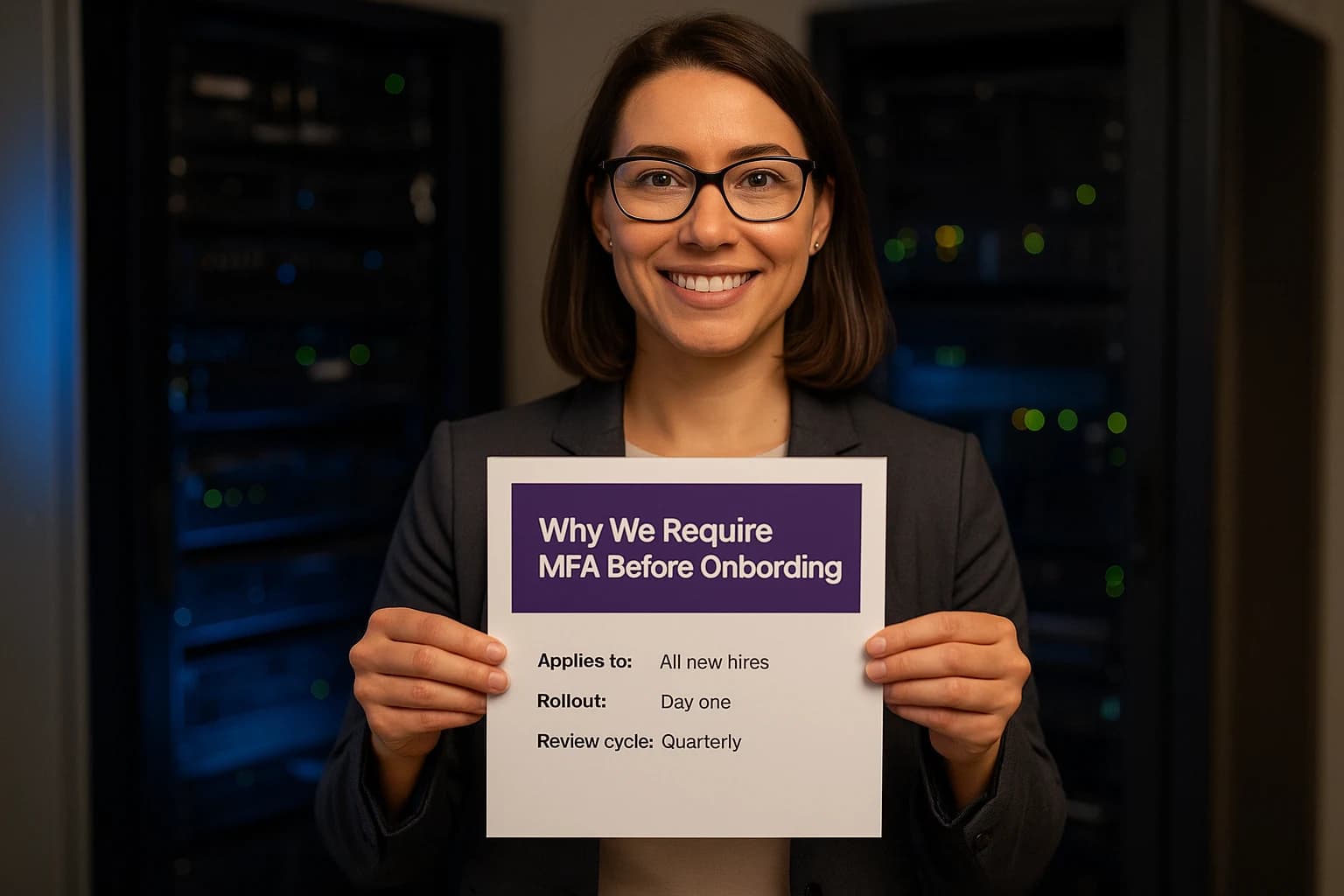
Why you require multi-factor before you will onboard anyone. Why you will not support an operating system past end of life. What your patch window really is and what happens when a client asks you to skip it. This one closes deals, because it tells a buyer what having you would be like on a Tuesday.
The vendor or licence change explainer
When a licence model changes, a product hits end of life, or a price goes up, your clients ask you the same question in the same week. Write the answer once, in public, in plain language. It is timely, it is genuinely useful, and it is the kind of thing a client forwards to somebody who is not a client yet.
Hiring and the people who work there
A new engineer, a certification somebody earned, the reason you were hiring at all. It reads as a firm that is growing rather than holding on, and it works twice: LinkedIn Talent reports 7 hires per minute and around 3 million a year through the platform, and that 77% of recent job-changers used LinkedIn. The post that reassures a buyer also reaches the engineer you want.
How you package and what it costs
Most managed services websites hide this and most buyers resent it. You do not have to publish a price list. Publishing how you package, what is in and out of scope, and what makes a quote go up is enough, and it filters out the prospects who were only ever going to be a bad fit.
The vertical or local anchor
Named industries and a named service area. A dental group and a machine shop do not have the same problems, and the firm that says which one it knows beats the firm that says it serves everyone. Specificity is what makes a page worth ranking for and a post worth forwarding.
What nobody reads
- Awareness month posts that could carry any logo.
- A vendor graphic reposted with no comment of your own on it.
- Five tips to stay safe online, written for nobody in particular.
- A statistic with no source a reader could go and check.
- The sentence about being a partner rather than a vendor, which every competitor in your county has also published.
Where to put it
In order of return per hour for a provider whose week belongs to clients. Notice that the top of this list is almost entirely unglamorous and needs no software.
Your own site, before anything else
The pages that get read are not the blog. They are the one that explains how you package and what drives a price, the one that names the industries you actually serve, and the one with the team on it and real faces. If those three are weak, publishing more will not rescue them, it will just send more people to see them.
LinkedIn, on two surfaces doing two different jobs
The place the buyer verifies you, and the place a referral goes to look you up. Most providers run one badly and the other not at all. The next section is entirely about the split, because it is the part nobody writes down.
Reviews, asked for at the right moment
Google, plus the two or three directories your buyers genuinely use. The mistake is asking in a quarterly push. Ask at the moment a ticket ends well and the client is grateful, which is the only moment the answer is yes. This costs nothing and no software is required.
The inbox of the clients you already have
The most underrated surface a managed services firm owns. A short monthly note to people who already pay you produces more referral than any post will, because they are the ones being asked who you use for IT. It is the cheapest item on this page and it needs no tool.
Vendor and distributor marketing funds
Most of the vendors you already resell run channel marketing programmes, often called market development or co-op funds, and a lot of small providers never claim a dollar of theirs. Ask your distributor rep what your tier qualifies for and what it may be spent on. Nothing on this page has a better return per hour, and it has nothing to do with any software.
The people who get asked before Google does
The accountant, the attorney, the insurance broker, the commercial realtor, and the peer groups you are already in. They are asked who you use for IT more often than a search engine is, and they can only answer with a firm they can describe. Give them the sentence.
Where each channel actually breaks
Ordered by what actually produces signed managed services contracts, not by what is easiest to sell you. You have probably tried most of these already. Here is where each one breaks, and the version worth doing anyway.
1. The clients you already have
Where it breaks
It is capped by two numbers you do not control: how many clients you have, and how well those clients can describe you to somebody else. It also stops without warning when a champion leaves a company. And it produces no leads at all in the month you decide you need leads, which is exactly when providers go looking for something faster and get sold something worse.
The version worth doing
Ask at the moment a ticket ends well and the client is grateful, which is the only moment the answer is yes. Send one short note a month to people who already pay you, because they are the ones being asked who you use for IT.
2. The people who get asked before a search engine does
Where it breaks
A referral partner can only recommend a firm they can describe in one sentence. If you have not given them that sentence, they default to whoever they met most recently. It also needs reminding: a partnership set up in January and never touched again produces nothing by June, and nobody tells you it went quiet.
The version worth doing
Write the sentence yourself, say it to their face, and give them one concrete thing to look out for. A firm that just failed an insurance questionnaire, a client complaining about their current provider, a business being acquired.
3. Your vendors, your distributor, and your peer group
Where it breaks
Vendor-sourced leads are usually shared with other partners, so treat them as a warm introduction rather than an exclusive. The funds are real but they arrive with rules about what they may be spent on, and the lag between the conversation and the money is measured in months.
The version worth doing
One phone call to your distributor rep: what does my tier qualify for, and what may it be spent on. Most small providers never make it. Nothing on this page has a better return per hour, and it involves no software of any kind.
4. Outbound, at low volume, by a human
Where it breaks
The hit rate is brutal and it is mostly a timing problem rather than a pitch problem. Roughly speaking, a business with a provider is not shopping, no matter how good your opening line is. At volume it gets worse rather than better: high volume sending from a throwaway domain converts your one deliverable asset into a complaint rate, and in several jurisdictions it carries legal exposure the people selling it rarely raise.
The version worth doing
If you are going to do outbound, do it narrow. A named list of businesses in your two verticals, in your service area, with a reason to be calling this month. Fifty of those beat five thousand of anything else.
5. Publishing, in your own name
Where it breaks
It is the slowest thing on the list and it does not move the pipeline in a measurable way inside a quarter. It also fails silently if your position is vague: a competitor could sign most managed services posts without changing a word, and a post like that generates nothing but a like from a vendor rep.
The version worth doing
Four pieces a month drawn from what actually happened, split between your Company Page and your own profile, on the cadence set out above.
6. Search, on a small number of pages
Where it breaks
The obvious money words in this category are held by agencies running hundreds of pages, and a monthly drip of thin articles is the cheapest known way to spend a year and learn nothing. It is also gated on the site converting: traffic to a page that does not say what you cost or who you serve produces a bounce, not a lead.
The version worth doing
Write the six pages properly, once, and then stop. Then go back and make the packaging page good, because it is the one that decides.
7. Paid search, once the basics exist
Where it breaks
It breaks in two predictable places. The click lands on a homepage instead of a page about the thing they searched for, and nobody answers for a day. Both are fixable and both are usually still broken when the budget starts. It is also a specialist skill, and an expensive place to learn on your own money.
The version worth doing
Do not start until the packaging page exists and somebody has agreed to answer inside the hour. Then hire a person who does this for a living, rather than learning it yourself at these click prices.
Your Company Page and your own profile do different jobs
Most managed services firms run one of these badly and the other not at all, and the reason is that they get treated as the same surface with two logins. They are not the same surface, and the split is worth getting right because it is free.
The Company Page is a credential check
It is what somebody opens to confirm you are a real firm rather than one person with a laptop. It needs to look alive far more than it needs to be clever: recent activity, real headcount, a description that says what you do and for whom, and visible evidence of the last few months. Almost nobody reads it for insight. They read it for reassurance and then they leave. It also outlives your attention. It is the surface that still says the company exists on a day you are not the one posting.
Your own profile is where trust is built
People follow people. When a referral says talk to Dave at that firm, the person looks up Dave, not the firm. Your profile is already doing that job whether you post or not, which is why the headline, the about section, and the first two visible posts are worth an hour of your time even if you never publish again.
What goes where, as a rule of thumb
Anything a competitor could sign their own name to belongs on the Company Page: service notes, hiring, certifications, client wins you have permission to name, the vendor explainer. Anything that only works because a specific human said it belongs on your profile: the judgement call, the thing you got wrong, the opinion about a vendor, the reason you turned a piece of work down.
One mechanical difference that matters
A Company Page has real admin roles, so bringing a colleague or a helper in is legitimate, supported, and needs no software at all. A personal profile has no such thing. So the honest options for getting help with your own profile are that you do it yourself, or that you use a tool the platform actually authorises. Handing your LinkedIn password to whoever is helping with marketing is the common answer and it is a bad one.
On reach, expect the Company Page to start slower than a person, always. Post on both and let your profile carry the audience for the first year. LinkedIn Marketing Solutions reports that pages posting weekly grow followers 7x faster than pages that do not, which is an argument for a dull kept rhythm rather than a burst of five posts in a good week.
One more reason to be specific in public, and it is newer than most advice on this subject. When somebody asks an AI assistant for a managed services provider in their area, the assistant is assembling that answer out of public text, and LinkedIn is unusually well represented in what it reads: across AI search engines in 2026, LinkedIn ranks number 3, above Wikipedia (Peec AI, March 2026). Naming your city, your industries, and the platforms you support in plain sentences is now a way of being findable by something that is not a search engine.
A cadence you can actually keep, in a bad month and a good one
The honest number is lower than any guide will tell you. One post a week, held for a year, beats four a week for six weeks followed by nothing. An abandoned account is worse than a quiet one, because it is dated: it tells a visitor exactly which month you stopped caring.
The other half of a survivable rhythm is deciding in advance what you will not do. No daily posting. No video series. No newsletter until the posts have been habitual for six months. Every one of those is a good idea that has killed more small-firm marketing than doing nothing ever did.
Ninety minutes is a floor, sized for the smallest shop reading this page. A firm with a dispatcher or an office manager can split that block across two people, or spend a little longer once the habit is proven. What does not change with headcount is the discipline: one recurring block that happens every month, rather than a bigger plan that depends on somebody remembering to run it.
1,182
more impressions per post at 2 to 5 posts a week
Buffer, 2025
3x
more engagements for the most consistent posters
Buffer, 2025
~2%
of LinkedIn members publish weekly at all
Derived from LinkedIn, 2019
All three describe consistency rather than a burst. If 2 to 5 a week is not survivable, one held every week is the right answer.
Decide who you are for, in one sentence
Name the two or three industries you actually know and the stack you standardise on. Everything else on this list follows from that sentence, and no tool and no agency can write it for you.
Fix the three pages that get read
How you package and what drives a price, the industries you serve, and the people who work there. Repair those before you publish anything that sends traffic to them.
Block ninety minutes on the same day every month
One recurring block on a calendar, treated like a client meeting. This is the whole time commitment. A plan that needs more than this from whoever is running it, on top of everything else they already do, is a plan that gets abandoned in month three.
List the four real things that happened
An incident you handled, a vendor or licence change your clients asked about, a hire or a certification, and a question you answered more than once this month. Those four are your month. You are not inventing topics, you are writing down what already occurred.
Draft all four in that same sitting
Do not spread drafting across the month. The block is the habit, and the habit is the only thing that survives a busy quarter.
Split them between the Company Page and your own profile
The ones any firm in your market could sign go on the Company Page. The ones that only work because you personally said them go on your profile.
Schedule them across the weeks and close the tab
Pick the dates in the same sitting so publishing is not a decision you have to make again on a day you are firefighting.
Add one question to your first sales conversation
How did you come to call us, and what did you look at before you did. Write down every answer. Twenty of those is better market research than any dashboard, and it is free.
The ninety day test
Managed services has a long, lumpy sales cycle and marketing attribution in this category is genuinely poor. Anybody who tells you they can trace a signed contract cleanly back to a post is selling you a dashboard. So the ninety day test measures execution and leading signals, and it is explicit about which of the six are pass or fail and which are not.
- 1
Did the block survive three months out of three?
Pass or failPass or fail, no partial credit. If it did not survive, the plan was too big for the business, and the fix is to cut it rather than to try harder next quarter.
- 2
Are there twelve published pieces? Count them.
Pass or failFour a month, three months. Eight is not a pass. This is the only production number in the plan and it is the one that everything else depends on.
- 3
Can you say who you are for in one sentence, out loud, without hedging?
DirectionalSay it to somebody who works with you and watch their face. If they add a qualifier for you, it is not finished.
- 4
Has one first conversation started at a specific question?
DirectionalInstead of starting at an explanation of what managed services is. One is a real signal at ninety days. Zero is normal and is not evidence of failure.
- 5
Do you have ten verbatim answers to how did you come to call us?
DirectionalThis is your whole attribution system. Ten of them tells you more than any dashboard sold into this category, and it costs one line in a conversation you were having anyway.
- 6
Has a referral partner used your own sentence back at you?
DirectionalThe slowest of the six and the most valuable. It means the people who recommend you have learned how to describe you, which is what the published positioning was for.
Checks one and two are the ones to hold yourself to at ninety days. Checks three to six are read at nine to twelve months, and reading them early is the most common reason a plan that was working gets cancelled. If the block did not survive, cut the pieces, never the block: two a month, or one, with the calendar entry exactly where it was.
What to say when your differentiator is trust
Every managed services website in your market says the same four things: proactive, responsive, around the clock, and a partner rather than a vendor. They are all true, and not one of them differentiates, because your competitor published them too and the buyer has read both sites in the same afternoon.
Trust is not a claim you can assert. It is a claim you can make expensive to copy. That is the working test: would a competitor be willing to publish this exact sentence about themselves? If yes, cut it. Four things survive that test.
Say what you run
Name the stack. We standardise on this, and here is what we will not support, is a real position. It costs you a few prospects and it wins the ones who wanted exactly that. A firm that supports everything is telling a buyer it has no opinion.
Say who you are for
Two or three verticals, named on the site and repeated in what you publish. It is the fastest way to stop competing on price with providers who do everything for everybody.
Publish a commitment with its definition attached
A response time is only credible if you also say what counts as a response and what happens when you miss it. A vague guarantee reads as marketing. A defined one reads as an operating decision somebody had to argue about internally, which is exactly the impression you want.
Say what you refuse
The work you will not take, the practices you will not support, the client behaviour that ends the relationship. Nothing signals a real operation faster than a stated no, and almost nobody is willing to publish one.
And the case study, honestly. A named client with permission and a number you can defend is worth more than anything else on this page, and it is also the hardest thing to get. Ask at renewal when the relationship is good, not in the week after an incident. If the client will not be named, publish the write-up without the name and say why. An anonymous account of something real still works. An invented one does not, and in a market where every provider knows every other provider, inventing one is a risk you would not take twice.
How to tell whether it is working
Managed services has a long, lumpy sales cycle, and marketing attribution in this category is genuinely poor. Anybody who tells you they can trace a signed contract cleanly back to a post is selling you a dashboard. So use leading indicators, and one human question.
The human question is the strongest signal available to you and it costs nothing. Add one line to your first conversation: how did you come to call us, and what did you look at before you did. Write down every answer verbatim. Twenty of those beats any analytics tool you could buy, and it is the only method on this page that tells you what people actually saw.
How did you come to call us, and what did you look at before you did. Twenty of those beats any analytics tool you could buy.
The only free attribution system in this category
- 1
Whether people arrive already knowing something
The clearest sign your published work is landing is a first conversation that starts at a specific question rather than at an explanation of what managed services is. Track the shift, not the number.
- 2
The quality of referrals, not just the count
When referrals start arriving better qualified, it means the people referring you have learned how to describe you. That is what your published positioning is actually for.
- 3
Who is looking, more than how many
Profile and page views around the days you publish, read for identity rather than volume. In a category with a few dozen realistic buyers in a region, one right name is worth a thousand wrong ones.
- 4
Searches for your firm plus your city or vertical
Branded search combined with a place or an industry is the closest free proxy you have for reputation reaching people who have not met you.
- 5
Post engagement, last, and only as a tie-breaker
Useful for deciding which of two topics to write more about. Useless as a goal. Likes are the weakest signal on this list and the easiest to chase by accident.
What to ignore: follower count as a goal, engagement rate as a target, and the performance of any single post. And one expectation worth setting for yourself before you start. For a firm that publishes a few hours a month, publishing does not move the pipeline in a measurable way for months. Anyone promising otherwise is describing paid advertising, which is a different budget with a different risk and is not what this page is about.
Do by hand, hire a person, or use a tool
Row by row, with our own column marked the same way as the other two. Where paying a person is the better answer the row says so, and three of the eleven rows are things no supplier can do for you at all. If the firm has an office manager or a dispatcher, several of those rows are just as easily theirs; what matters is that a person close to the work does them, not that it has to be whoever owns the firm.
| Feature | By hand | A person you pay | Blendin |
|---|---|---|---|
| Choosing your verticals and your stackYours alone. No supplier can make this call. | Yes | No | No |
| Rebuilding the websiteHire this one. | Possible, slowly | Yes | No |
| Site SEO and the packaging pageHire this one. | Possible | Yes | No |
| Getting the incident out of your head | Yes | Bills you to chase you | A short guided interview |
| Writing and designing the four pieces a month | The part that fails | Yes | Yes |
| Keeping every piece in your real brand | Drifts | Yes | Yes |
| Publishing to the Company Page and your profile | Yes | If you share access | Yes |
| Asking clients for a reviewNobody can do this for you, and it is five minutes a week. | Yes | No | No |
| Claiming vendor marketing fundsOne phone call, and the best return on this page. | Yes | No | No |
| Paid searchHire a specialist or leave it alone. | No | Yes | No |
| Agreeing a named case study with the client | Yes | The draft, not the conversation | No |
Be suspicious of any software sold to you as a marketing department, ours included.
Twenty six ideas, with a time cost against each
Everything above fits inside the ninety minute block or is one of the relationship items that costs a phone call rather than an hour. This is the full lookup: every idea this page has named, with a recommended budget in the owner's own hours and who can sustain it. The times are a recommended budget, not a measured average of anything.
| Idea | Time budget |
|---|---|
| The incident write-up, with the client removed | Budget 30 minutes, whenever one happens.Who: Owner or lead engineer. Nobody else has the facts. |
| A policy you actually enforce, and why | Budget 20 minutes. One policy per post.Who: One person. |
| The vendor or licence change explainer | Budget 30 minutes, when it happens.Who: One person. |
| The question you answered three times this quarter | Budget 20 minutes.Who: One person. |
| A hire, a certification, or the reason you were hiring | Budget 15 minutes.Who: One person, and it is the easiest thing to delegate. |
| The piece of work you turned down, and why | Budget 20 minutes.Who: Owner. |
| Something you got wrong and changed | Budget 30 minutes.Who: Owner only. |
| What you are standardising on next year, and what you are dropping | Budget 30 minutes, annually.Who: Owner. |
| The packaging page: what is in, what is out, what makes it go up | Budget one afternoon, once, then edit yearly.Who: Owner to decide, and worth paying a writer to shape. |
| A real page for each industry you serve | Budget half a day per industry, once.Who: Owner plus a writer. |
| A team page with real names and real faces | Budget two hours plus a photographer for a morning.Who: One person to organise. |
| The review ask, at the moment a ticket ends well | Budget five minutes a week, forever.Who: Whoever closed the ticket. No software required. |
| A response commitment with its definition and its consequence | Budget one hour, once. The argument takes longer.Who: Owner and service lead. |
| A named case study, with permission | Budget several hours plus a client conversation.Who: Owner for the conversation, a writer for the draft. |
| The anonymous version of the same story | Budget one hour.Who: Owner. |
| One sentence your referral partners can repeat | Budget one hour to write, then a conversation each.Who: Owner. |
| A short monthly note to the clients you already have | Budget 30 minutes a month.Who: One person. |
| A talk at a local industry association or chamber | Budget a day, twice a year.Who: Owner. Not delegable. |
| A thirty minute session on the thing clients keep asking about | Budget a day of preparation, quarterly.Who: Needs a second pair of hands for the logistics. |
| Being a guest on somebody else's podcast or newsletter | Budget two hours including preparation.Who: Owner. |
| A peer group of other providers | Budget a real commitment, ongoing.Who: Owner. |
| Your vendor and distributor marketing funds | Budget one phone call.Who: Owner. Best return per hour on this page. |
| A website rebuild | Weeks, and a real invoice.Who: A person you pay. |
| Paid search | Ongoing budget plus a specialist.Who: A person who does this for a living. |
| A table at a trade or association event, with the follow up agreed first | Two days out of the business, plus the stand.Who: Two people minimum. |
| A fractional marketer or a specialist agency | A monthly retainer.Who: External. |
A finished piece, not a blank page
The incident, the licence change, the policy you enforce. You supply what happened and each piece comes back written and designed in your firm's own colours and type, ready to approve or to schedule for the day you picked.
MSP marketing questions, answered in one line
Every row is one question somebody running the firm actually types, with the short answer beside it. Three of them go deeper, earlier on this page: the ninety day test, where each channel breaks, and the full time budget table.
| What owners ask | The short answer |
|---|---|
| What is MSP marketing? | Making sure that when somebody asks around or looks you up, what comes back reads as the established, specific, still here option.Referral wins the work. Publishing is how referral reaches people who have not met you. |
| How much should an MSP spend on marketing? | Time before money. Ninety minutes of somebody's time a month, held every month.Money is the right lever once the position is chosen and the website already says it. |
| How often should an MSP post? | Four pieces a month, or one a week held for a year. Consistency beats volume.An abandoned account is dated. It tells a visitor which month you stopped. |
| Company Page or my own profile? | Both, doing different jobs. The page is the credential check, your profile is where trust is built.Anything a competitor could sign goes on the page. Anything only you could say goes on your profile. |
| What should an MSP publish? | Records of what already happened: an incident, a policy you enforce, a licence change, a hire, a refusal.Six kinds of piece, with what nobody reads beside them. |
| What goes in an MSP marketing plan? | Eight items on one page: two sentences, three pages, one monthly block, four records, three habits.The full version, with a ninety day pass or fail test, is above. |
| Where do MSP leads actually come from? | Existing clients, then referral partners, then vendors and your peer group, then narrow outbound, then publishing, then a few pages, then paid search.Each of those carries its own failure mode, detailed above. |
| What counts as an MSP lead? | Only a qualified opportunity. A name is not a lead and an enquiry is a lead nobody has qualified yet.Counting names is how a healthy chart sits above an empty quote pipeline. |
| How long does each marketing idea take? | Fifteen to thirty minutes for a record, an afternoon for a permanent page, one phone call for vendor funds.Twenty six ideas with a time budget against each are listed above. |
| Does an MSP need a blog? | Probably not the blog you are imagining. Six permanent pages and a monthly rhythm of records instead.A monthly drip of thin search articles is the cheapest way to spend a year and learn nothing. |
| Should I hire an MSP marketing agency? | When the constraint is strategy and coordination. Not when nothing is being produced at all.With nothing being produced they will mostly bill you to chase you for the raw material. |
| Can AI write our marketing? | It can produce, it cannot know. The incident and the policy live in your head until somebody gets them out.Which is why Blendin starts with a short guided interview rather than with a topic. |
| How do we compete with a private equity backed provider? | On what their scale costs them. Look established and specific rather than large.Accounts handed to a queue and an owner several layers away are real reasons to buy from you. |
| How do we know it is working? | Ask every first conversation how they came to call you, and write the answer down verbatim. Twenty of those beats a dashboard.Attribution in this category is genuinely poor. Leading signals and one human question are what is left. |
The production half, in your own brand
Blendin is built for the situation this page describes: a B2B services company with real expertise that has to look established to win the contract.
You paste your website URL. Blendin reads your real colours, fonts, logo and tone from it and builds a brand kit, and it never invents a brand colour that is not actually there. Then it writes and designs each piece in that brand: text posts, carousels, image posts, and native LinkedIn Documents, which is the right format for anything longer than a paragraph. It publishes to your LinkedIn personal profile and your Company Page, plus Instagram, Facebook and Threads on the Starter plan, with TikTok on Pro and up.
Two things matter for the trust problem this page is about. A short guided interview, typed or spoken, turns what you actually know into durable notes the writing draws on, so the incident and the policy and the reason you refuse a piece of work come out in your words. It works from your real answers and it never invents facts. And the writing is checked against the tells that give AI content away and rewritten until it reads human, because a post that reads generated costs you exactly the credibility you were publishing to build.
Publishing runs through each platform's own official partner API, inside their Terms of Service. Blendin runs on its own official LinkedIn app, approved on the LinkedIn Community Management API at the Standard Tier, and is a Verified Meta Tech Provider. Not a browser extension, and it never asks for your LinkedIn password. You approve or schedule every post, so nothing goes out that you have not seen.
What Blendin does not do
- It does not decide your positioning. If you have not chosen your verticals and your stack, no software helps, and this page put that decision first for a reason.
- It does not rebuild your website or do your site SEO. If the three pages that get read are weak, fix them first, by hand or with a person you pay.
- It does not run advertising of any kind.
- It does not manage replies or run a shared inbox. Conversations still happen on the platform, with you in them.
- It cannot write a case study you have not agreed with the client. That conversation is yours, and the write-up is worth more than anything else you will publish.
- It will not claim your vendor marketing funds, ask your clients for reviews, or talk to your referral partners. Those are three of the highest-return items on this page and all three are entirely yours.
$59 a month. New accounts start with a 14 day free trial of the full Starter plan, card required, no charge today, cancel anytime.
The incident is in your head. A short guided interview
Typed or spoken, a few questions at a time, and its answers become durable notes the writing draws on. It works from what you really said and it never invents a fact, which is the whole point in a category where a fabricated case study would be recognised by the second provider who read it.
Questions MSP owners actually ask
How much should an MSP spend on marketing?
We are not going to hand you a percentage of revenue, because any figure we could quote would be somebody else's average applied to your business. For a provider whose week belongs to clients the more useful frame is time before money: ninety minutes of somebody's time a month, held every month, produces more than a budget spent once. Money becomes the right lever when you have something worth putting behind it, which usually means a positioning you have chosen and a website that already says it clearly. Before that, spending buys traffic to pages that do not convert.
Does LinkedIn actually work for MSPs, or is it just for recruiters?
It works, but not the way a consumer brand uses it. Your buyers are owners, finance leads, and operations managers, and LinkedIn is where they verify a firm somebody just recommended. It is a checking surface first and a discovery surface second, which is why looking alive matters more than being clever. It also carries an effect that is newer than most guides: across AI search engines in 2026, LinkedIn ranks number 3 above Wikipedia (Peec AI, March 2026), so what you and your firm have written in public is now material that assistants assemble answers from when somebody asks them for a provider.
Should I post from the company page or from my own profile?
Both, doing different jobs. The Company Page is the credential check: it needs recent activity, real headcount and a clear description, and it is what still says the company exists on a day you are not posting. Your own profile is where trust is built, because a referral looks up the person, not the firm. Practical split: anything a competitor could sign goes on the page, anything that only works because you personally said it goes on your profile. Expect the profile to carry the audience for the first year. LinkedIn Marketing Solutions reports that pages posting weekly grow followers 7x faster than pages that do not, which is an argument for a boring kept cadence rather than a burst.
How often does a managed services provider need to post?
Less often than you have been told, and far more consistently. One post a week held for a year beats four a week for six weeks and then silence, because an abandoned account is dated and tells a visitor exactly when you stopped. Buffer's 2025 analysis found that posting 2 to 5 times a week is associated with about 1,182 more impressions per post, and that the most consistent posters see 3x more engagements. Both figures describe consistency, not a burst. If 2 to 5 is not survivable, one held is the right answer, and it still puts you ahead of the roughly 2% of LinkedIn members who publish weekly at all (derived from LinkedIn 2019).
Our differentiator is service quality. How do we market that without sounding like every other provider?
By making the claim expensive to copy. Every managed services site in your market says proactive, responsive, around the clock, and a partner rather than a vendor. They are all true and none of them differentiates, because your competitor published them too. The test is whether a competitor would be willing to publish your exact sentence about themselves. If yes, cut it. What survives: the stack you standardise on and what you refuse to support, the two or three industries you actually know, a response commitment with its definition and its consequence attached, and a written no. A specific position loses you a few prospects, which is how the remaining ones know it is real.
Do we need a blog?
Probably not the blog you are imagining. A monthly cadence of thin articles written for a search engine is a common way for a provider to spend a year and learn nothing. What earns its keep is a small number of pages that answer questions your buyers really ask, the vendor and licence explainers your clients already email you about, and the three pages people actually read: packaging and price drivers, industries served, and the team. If you write those and nothing else, you are ahead of most of your market.
Should I hire an MSP marketing agency?
Hire one when the constraint is strategy and coordination rather than production. If you already publish and the problem is that you do not know what to aim at, buy the thinking. If nothing is being produced at all, an agency will mostly bill you to chase you for the raw material, because the incidents and the policies and the reasons live in your head. Two other things are worth paying a person for regardless: a website rebuild if yours genuinely does not say what you cost or who you serve, and paid search if you decide to fund it, since it is a specialist skill and an expensive place to learn on your own money.
Can AI write our marketing for us?
It can produce. It cannot know. The facts that make managed services marketing convincing, the incident, the policy, the reason you turned work down, exist only in your head until somebody gets them out. That is why Blendin starts with a short guided interview, typed or spoken, and writes from your real answers rather than from a topic. The other half is protective: a post that reads generated costs you exactly the credibility you were publishing to build, so the writing is checked against the tells that give AI content away and rewritten until it reads human. What no tool can do is choose your position or agree a case study with a client.
We are up against a private equity backed regional provider. What do we do?
Do not try to look like them, because you cannot out-brochure a company that has a marketing department. Compete on the things their scale actually costs them. Rolled-up providers get bigger and less personal, accounts get handed to a queue, and the owner who used to answer the phone is now several layers away. Every one of those is a genuine reason a business would rather buy from you, and none of it is visible to a prospect unless you publish it in your own name. Look established and specific rather than large: obviously real, obviously still here next year, obviously good at one particular kind of work.
Ninety minutes a month, in your own brand
Paste your URL, tell Blendin what happened this month, and get finished pieces that look like your firm and go out on the days you picked. You approve every one.
Start free trial